
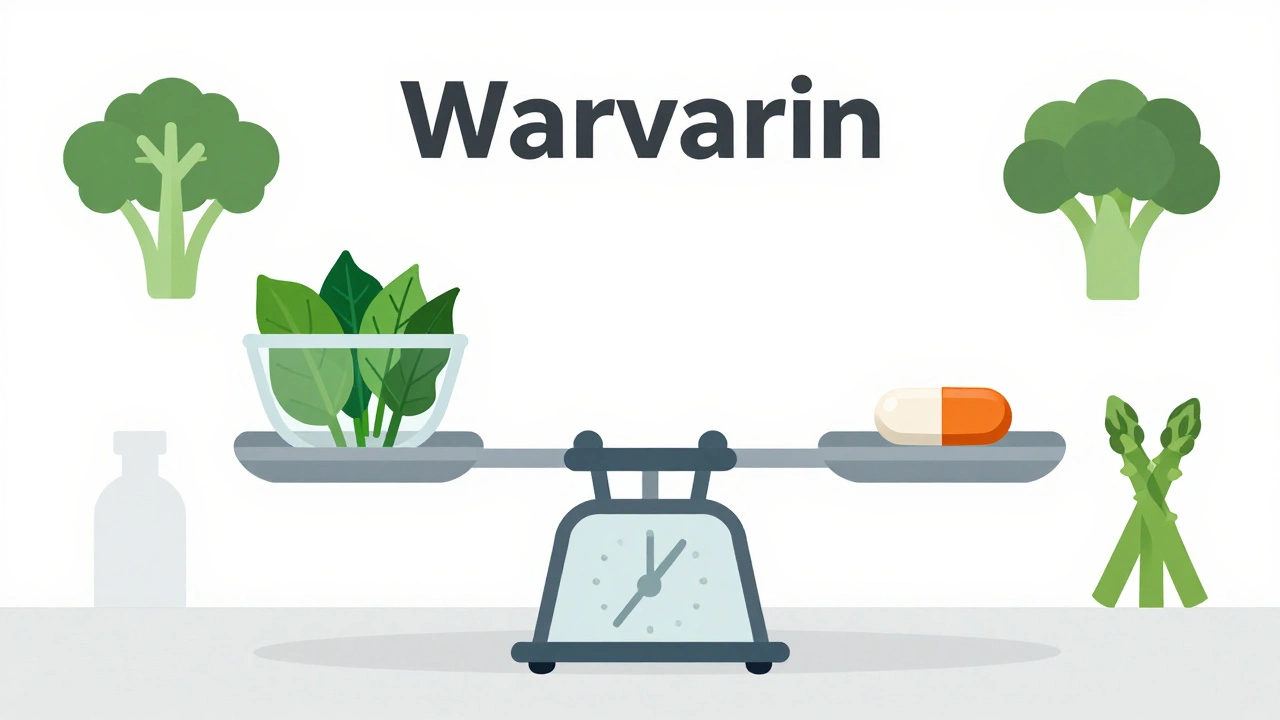
Vitamin K Intake Calculator
Track your daily vitamin K intake to maintain stable INR levels while on warfarin therapy. Consistency is key—this tool helps you measure your daily intake against the recommended range of 90-120 mcg.
Daily Vitamin K Sources
Daily Vitamin K Intake
Enter amounts of vitamin K-rich foods to calculate your total daily intake.
Consistency is key for stable INR levels. The ideal range is 90-120 mcg per day with minimal variation. If your intake varies by more than 30 mcg between days, your INR may fluctuate.
Cooking concentrates vitamin K. Raw spinach has about 145 mcg per cup, but cooked spinach has nearly 900 mcg. Always log your food as it's prepared, not raw.
When you're on warfarin, your body is balancing on a tightrope. Too much clotting, and you risk a stroke or pulmonary embolism. Too little, and you could bleed internally from a minor bump. The key to staying safe isn't avoiding certain foods-it's eating the same amount of vitamin K every day. This isn't about fear. It's about control.
Why Vitamin K Matters More Than You Think
Warfarin works by blocking vitamin K from helping your blood clot. That’s exactly what you want-until your vitamin K intake jumps around. If you eat a big plate of cooked spinach on Monday and skip greens all week, your INR (the number that measures how long your blood takes to clot) will swing like a pendulum. One day it’s 2.8, safe. The next, it’s 1.7, and your doctor has to scramble to adjust your dose. The science is clear: vitamin K directly opposes warfarin. Every microgram you consume reduces warfarin’s effect. A single cup of cooked spinach contains nearly 900 micrograms of vitamin K. That’s more than seven times the daily recommended intake for a healthy adult. And if you’re used to eating only 50 micrograms a day, suddenly eating that much spinach can drop your INR by 1 point in under 72 hours.It’s Not About Avoiding Greens-It’s About Routine
For years, patients were told to avoid spinach, kale, broccoli, and other dark leafy greens. That advice is outdated, dangerous, and wrong. The American Heart Association, the American College of Cardiology, and the American Society of Hematology all agree: don’t restrict vitamin K. Stick to it. Here’s why restriction backfires. If you cut out greens completely, then eat a salad at a friend’s house, your body gets hit with a sudden flood of vitamin K. Your INR crashes. You might need a shot of vitamin K or even a hospital visit. But if you eat one cup of cooked kale every day-same portion, same time-you train your body to adapt. Your INR stays steady. Your warfarin dose stays steady. Your life stays predictable. Studies show patients who eat 90-120 micrograms of vitamin K daily with little variation spend 75-80% of their time in the safe INR range. Those who eat wildly different amounts each day? Only 55-65%. That’s a huge gap when your life depends on it.What Foods Are High in Vitamin K? (And How Much?)
Not all greens are created equal. Portion size and cooking method matter more than you realize.- 1 cup cooked spinach: 889 µg
- 1 cup cooked kale: 547 µg
- 1 cup cooked collard greens: 772 µg
- 1 cup cooked broccoli: 220 µg
- 1/2 cup cooked asparagus: 70 µg
- 1/2 cup green beans: 14 µg
- 1 cup raw lettuce: 20 µg

How to Build a Stable Routine
You don’t need to become a nutritionist. You just need to be predictable. Step 1: Pick one high-vitamin K food to eat daily. Choose one you like. Kale? Broccoli? Spinach? Stick to it. One cup. Every day. No more. No less. Step 2: Keep other days simple. On days you don’t eat your main source, stick to low-vitamin K veggies: carrots, cucumbers, tomatoes, onions, bell peppers. Avoid switching between kale, spinach, and collards. That’s variation. And variation is the enemy. Step 3: Plan your meals weekly. Use a food diary or a free app like MyFitnessPal. Log your vitamin K intake. You don’t need to count every day forever-just until it becomes automatic. Most people find stability within 8-12 weeks. Step 4: Avoid big changes. Don’t suddenly start juicing kale. Don’t go vegan for a week. Don’t skip meals when you’re sick. Illness can lower your food intake and raise your INR. If you’re hospitalized or can’t eat for a day or two, call your anticoagulation clinic. They’ll tell you what to do.What About Supplements and Antibiotics?
Your gut makes some vitamin K too. But antibiotics wipe out those helpful bacteria. If you’re on antibiotics for a week, your body’s natural vitamin K production drops by up to 70%. That means your INR can rise-even if you eat the same food. Tell your doctor you’re on antibiotics. They may need to check your INR sooner. And skip vitamin K supplements unless your doctor prescribes them. Some studies show 100-150 µg/day of supplemental vitamin K can actually stabilize INR in people with wild swings. But that’s medical therapy, not a DIY fix. Don’t self-prescribe.
Why DOACs Are Easier-But Not Always Better
Newer blood thinners like apixaban and rivaroxaban don’t care what you eat. No vitamin K tracking. No INR checks. That’s why they’re popular. But they cost 20 times more than warfarin. And if you bleed, there’s no easy antidote-unlike warfarin, where vitamin K or fresh plasma can reverse it fast. For many people, especially older adults or those on Medicare, warfarin is still the only practical choice. And with the right routine, it works just as well.What If You’re Still Struggling?
If your INR keeps bouncing even after you’ve been consistent for months, talk to your anticoagulation specialist. You might need a different warfarin dose. Or maybe you’re unknowingly eating something high in vitamin K-like a green smoothie, a salad with added kale, or a vitamin-fortified protein bar. Some clinics now use apps like CoumaDiet or INR Tracker Pro that sync with your food logs and predict dose changes. If your doctor doesn’t mention them, ask. You’re not asking for a fancy gadget-you’re asking for safety.The Bottom Line
You don’t have to give up your greens. You just have to treat them like medicine. Take the same dose every day. No more. No less. That’s the only way to keep your INR steady, your dose stable, and your life free from emergency visits. Most people who follow this rule say the same thing: “I used to be scared of every bite. Now I just eat my spinach, and I sleep better.”Can I eat spinach if I’m on warfarin?
Yes, but only if you eat the same amount every day. One cup of cooked spinach (889 µg) daily is safer than eating none one week and three cups the next. Consistency beats restriction.
Does cooking affect vitamin K levels in greens?
Yes. Cooking reduces water content, concentrating vitamin K. Raw spinach has about 145 µg per cup. Cooked spinach has nearly 900 µg. Always log your food as it’s prepared, not raw.
Should I avoid all green vegetables on warfarin?
No. Avoiding greens increases risk. The current guidelines from the American Heart Association and American College of Cardiology recommend consistent intake, not restriction. Eating a steady amount of vitamin K stabilizes your INR better than avoiding it.
Can antibiotics affect my warfarin?
Yes. Antibiotics can kill gut bacteria that make vitamin K2, lowering your body’s natural supply. This can cause your INR to rise unexpectedly. Always tell your doctor if you’re on antibiotics while taking warfarin.
How long does it take to stabilize my INR with a consistent diet?
Most people see improvement within 8 to 12 weeks. INR stability typically increases by about 5% per month once dietary habits are consistent. Keep a food log during this time to track progress.
Is warfarin still used today, or are newer drugs better?
Warfarin is still prescribed to 35% of new atrial fibrillation patients in the U.S. because it’s affordable and has a proven reversal method. Newer drugs don’t need dietary tracking, but they cost up to $3,500 a year-far more than warfarin’s $150. For many, warfarin remains the best option when managed correctly.
What should I do if I miss my daily vitamin K food?
If you miss one day, don’t panic. Just return to your normal routine the next day. Don’t double up. If you miss multiple days due to illness or travel, contact your anticoagulation clinic. They may want to check your INR sooner than scheduled.
Are there apps to track vitamin K intake?
Yes. Apps like CoumaDiet and INR Tracker Pro are used by anticoagulation clinics and have been shown to improve INR stability. They use USDA data to log vitamin K content by portion and food type. MyFitnessPal also has a database that’s accurate enough for most users.
Katie Allan
December 5, 2025 AT 05:35Consistency is everything. I used to panic every time I ate kale, until I realized the problem wasn't the food-it was the chaos. Now I eat one cup of cooked spinach every single night, no exceptions. My INR hasn't budged in 14 months. It’s not magic. It’s discipline.
Stop treating your diet like a roulette wheel. You wouldn’t change your insulin dose daily-why treat warfarin differently?
Deborah Jacobs
December 5, 2025 AT 13:29I used to think I had to give up my green smoothies forever. Then I found out I could keep them-if I made them the same way every time. Same spinach. Same banana. Same almond milk. Same cup. Same time. It’s wild how the body just… adapts. Like a metronome. I didn’t know I could feel so calm about my health until I stopped fighting it.
Warfarin isn’t the enemy. Uncertainty is.
James Moore
December 6, 2025 AT 08:45Look, I’m an American, and I respect the science-but let’s be real: this whole vitamin K thing is just another example of Big Pharma pushing a cheap drug onto people who can’t afford the new ones. Warfarin’s been around since WWII, for crying out loud. The fact that we’re still telling people to count micrograms like they’re doing calculus at 3 a.m. is a national disgrace. Why not just make DOACs affordable? Why force seniors to log their broccoli like it’s a military mission?
It’s not about discipline-it’s about systemic failure. And don’t get me started on the fact that the FDA still hasn’t standardized vitamin K labeling on supplements. That’s not healthcare. That’s negligence.
Kylee Gregory
December 6, 2025 AT 18:10I appreciate how this post reframes the issue from fear to control. For so long, I felt like my diet was a minefield. Now I see it as a rhythm. I eat my broccoli every Tuesday and Thursday, and on the other days, I stick to carrots and tomatoes. It’s not perfect, but it’s predictable. And predictability? That’s peace of mind.
Also, I’ve started using MyFitnessPal to log my intake-just for the first 8 weeks. Now I don’t even need it anymore. My body just knows. It’s kind of beautiful, really.
Lucy Kavanagh
December 8, 2025 AT 05:24Wait-so you’re telling me the government and the doctors are telling us to eat more spinach… but only if we eat the SAME amount every day? That sounds like a trap. What if they’re just conditioning us to rely on processed foods that have ‘consistent’ vitamin K levels? What if this is all a way to get us hooked on meal replacement shakes? I’ve seen the ads for Ensure®-they’re everywhere now. Coincidence? I think not.
Who benefits from us eating the same exact cup of kale every day? The food industry. The lab companies. The doctors who get paid for INR checks. I’m not buying it.
Michael Dioso
December 8, 2025 AT 14:36Oh wow. Another one of these ‘eat the same spinach every day’ cult posts. Let me guess-you also brush your teeth with baking soda and meditate for 45 minutes before breakfast? This isn’t medicine, it’s wellness theater. You think your INR is stable because you ate kale? Newsflash: your liver and kidneys are doing the heavy lifting, not your salad bowl.
And for the record, if you’re still on warfarin in 2025, you’re probably not getting the best care. DOACs exist for a reason. Stop romanticizing the 1950s.
Krishan Patel
December 9, 2025 AT 18:15This is precisely why India has better health outcomes than the West: we follow tradition, not fads. In my village, we never ate raw greens with blood thinners-we cooked them, we measured them, we respected the balance. You Americans think you can fix everything with an app and a smoothie. But true health comes from discipline, not convenience.
And let me tell you, if your doctor does not know the difference between vitamin K1 and K2, then you are being misled. K2 comes from fermented foods, not spinach. You are confusing the two. This entire post is dangerously incomplete.
sean whitfield
December 10, 2025 AT 19:07So you're telling me the solution to complex anticoagulation therapy is… eat the same damn spinach?
Wow. Just wow.
Next you'll say the cure for cancer is drinking lemon water.
Thanks for the 2025 version of ‘eat your vegetables’.
Manish Shankar
December 12, 2025 AT 05:10With due respect, the scientific foundation of this approach is well-supported by clinical evidence. The American College of Cardiology's 2021 guidelines explicitly endorse dietary consistency over restriction. Furthermore, a meta-analysis published in the Journal of Thrombosis and Haemostasis in 2023 demonstrated a statistically significant improvement in time in therapeutic range (TTR) among patients adhering to stable vitamin K intake. The psychological benefit of routine should not be underestimated. It is not merely pharmacological-it is behavioral medicine.
luke newton
December 13, 2025 AT 18:50Everyone’s acting like this is some profound revelation. Newsflash: I’ve been on warfarin for 12 years. I’ve had three bleeds. I’ve had two strokes scare me into compliance. I don’t need a blog post to tell me to eat spinach. I need someone to fix the fact that my insurance won’t cover INR tests more than once a month. My doctor doesn’t even return my calls. So don’t lecture me about discipline when the system is rigged against me.
My INR swings because I can’t afford to check it. Not because I forgot my kale.
Jimmy Jude
December 15, 2025 AT 18:14Let me tell you about my cousin. She was on warfarin. She started eating kale every day. She got a nosebleed. Then she got a blood clot. Then she got a lawsuit. Then she got a new doctor. Then she got a DOAC. Now she’s fine.
So yeah. Eat your spinach. But don’t be surprised when your body says ‘enough.’
My cousin says she’s never felt safer. And she’s never eaten a leafy green since.
Mark Ziegenbein
December 16, 2025 AT 14:15Here’s the truth no one wants to say: warfarin is a relic. A 1940s drug with a 1940s diet plan. We’re asking people to be human calculators while the rest of medicine moved on. DOACs aren’t just easier-they’re more humane. And the fact that we still treat patients like lab rats with INR strips and food logs is a moral failure.
Yes, they cost more. But how much does it cost when someone ends up in the ER because they ate a salad with extra spinach? How much does it cost when a 72-year-old woman cries because she’s scared to eat broccoli?
Fix the system. Don’t fix the spinach.
Juliet Morgan
December 17, 2025 AT 13:47I’m not a nutritionist. I’m not a doctor. But I’ve been on warfarin for 5 years and I finally figured it out: one cup of cooked broccoli every night. That’s it. No stress. No apps. No guilt. I just do it. And now I sleep. Really sleep. For the first time in years.
You don’t need to be perfect. Just consistent. Even if it’s just one veggie. One cup. One day at a time. You got this.
Harry Nguyen
December 19, 2025 AT 01:26So let me get this straight. You want me to eat the same amount of spinach every day so my blood doesn’t clot or bleed out? Sounds like a recipe for a cult. Next thing you know, they’ll make us wear wristbands that say ‘I eat 889 µg.’
Meanwhile, the guy who eats fast food every day and takes his pill on time? His INR’s stable. Coincidence? I think not.
Stop making healthy eating a religion. It’s not about spinach. It’s about the pill.
Stephanie Fiero
December 20, 2025 AT 11:55OMG I just realized I’ve been eating raw spinach in my smoothie and then cooked kale for dinner-no wonder my INR was all over the place. I switched to one cup of cooked spinach every morning. No more smoothies. No more surprises. My last INR was 2.3. Perfect. I didn’t even know I was doing it wrong. Thank you for this. I’m not smart enough for this stuff but I can follow a rule.