
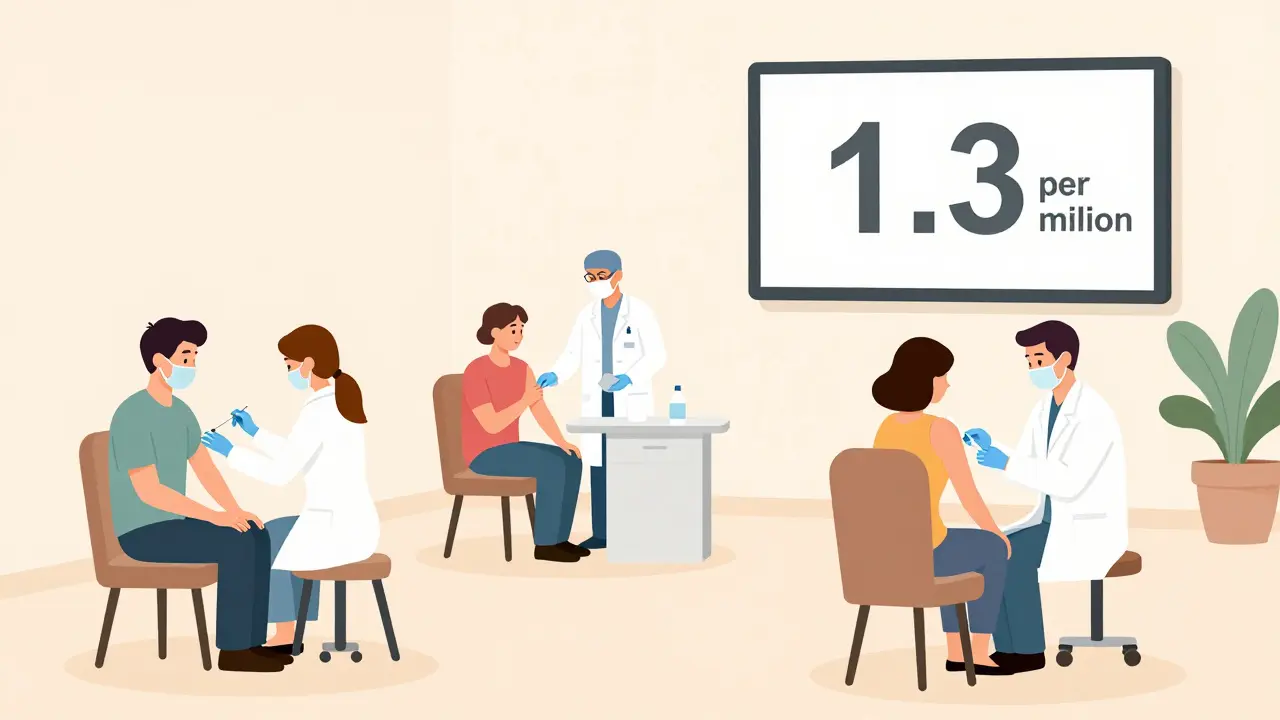
Most people get vaccinated without any issues. But every now and then, someone has a reaction-and when it happens, it’s scary. The question isn’t whether reactions occur, but how rare they really are, what causes them, and how we make sure they’re caught and handled fast. The truth is, serious allergic reactions to vaccines are extremely rare. In fact, you’re more likely to be struck by lightning than to have anaphylaxis after a shot.
How Rare Are Allergic Reactions to Vaccines?
Across all vaccines, anaphylaxis-the most serious type of allergic reaction-happens about 1.3 times per million doses given. That’s less than one in a million. For mRNA COVID-19 vaccines, the rate was slightly higher at around 5 to 11 cases per million doses during the early rollout. Still, that’s less than one in 100,000. To put it in perspective: if you filled a football stadium with people and vaccinated them all, you might see one reaction in the entire crowd.
These numbers come from massive studies tracking tens of millions of doses. The Vaccine Safety Datalink, which monitors vaccine safety across multiple U.S. health systems, analyzed over 25 million doses and found no pattern suggesting vaccines are broadly dangerous. Even with the billions of doses given since 2020, the number of confirmed anaphylaxis cases remains tiny.
What Causes These Reactions?
Not all reactions are true allergies. Some are just temporary side effects-like redness, swelling, or a rash-that aren’t caused by the immune system overreacting. True allergic reactions happen when the body mistakes something in the vaccine for a threat and releases histamine, triggering symptoms like hives, swelling, trouble breathing, or a drop in blood pressure.
For most vaccines, the culprit isn’t the virus or bacteria component-it’s the extras. In mRNA vaccines like Pfizer and Moderna, polyethylene glycol (PEG) has been identified as a possible trigger in some cases. PEG is used to stabilize the lipid nanoparticles that deliver the mRNA. It’s also found in some laxatives, cosmetics, and even toothpaste. People with known PEG allergies are advised to talk to an allergist before getting these vaccines.
Other ingredients that have raised questions include gelatin (in some flu and MMR vaccines) and yeast proteins (used in hepatitis B and HPV vaccines). But even here, the risk is minimal. Studies show that people with egg allergies can safely get flu shots-even those with a history of anaphylaxis to eggs. No special precautions are needed. The same goes for yeast: only about 15 possible cases were ever reported out of 180,000 allergic reaction reports in VAERS, and even those weren’t confirmed.
When Do Reactions Happen?
Timing matters. Almost all true allergic reactions happen fast. About 86% of anaphylaxis cases show symptoms within 30 minutes of vaccination. More than 70% happen within the first 15 minutes. That’s why clinics ask you to wait after getting a shot. For most people, 15 minutes is enough. If you’ve had a prior allergic reaction to any vaccine or injection, you’ll be asked to wait 30 minutes.
Most reactions start with itching, hives, or swelling around the face or throat. Some people feel dizzy, nauseous, or have trouble breathing. In rare cases, blood pressure drops quickly. That’s why clinics are required to have epinephrine on hand-and staff trained to use it. Epinephrine works fast. When given right away, it reverses the reaction in minutes.
Who’s at Higher Risk?
Women make up about 81% of reported allergic reactions after vaccines. The average age is around 40, but reactions have been seen in children as young as 3 months and adults over 80. That doesn’t mean women or middle-aged people are more allergic-it likely reflects who gets vaccinated most often. Women are more likely to seek medical care, report symptoms, and be included in surveillance systems.
People with a history of severe allergies-especially to injectables, medications, or previous vaccines-are at slightly higher risk. But having a food allergy, asthma, or eczema doesn’t increase your risk. A peanut allergy? No problem. A shellfish allergy? Still fine. The only exceptions are known allergies to specific vaccine components like PEG or gelatin.

How Do We Track These Reactions?
The U.S. has one of the most advanced vaccine safety systems in the world: VAERS, the Vaccine Adverse Event Reporting System. Run by the CDC and FDA, VAERS collects reports from doctors, patients, and vaccine makers. It’s not perfect-it gets about 30,000 to 50,000 reports a year, and most are unrelated to the vaccine. But it’s designed to catch signals early.
When a pattern emerges-like a spike in reactions after a new vaccine-experts dig deeper. For example, after the first mRNA vaccines came out, VAERS flagged a small number of anaphylaxis cases. That triggered a rapid review, which confirmed the rate was higher than with traditional vaccines-but still extremely low. That’s how the system works: not to prove every report is true, but to find things that need more study.
Other systems like v-safe, a smartphone-based tool launched during the pandemic, let people self-report how they feel after vaccination. Over 3.6 million people used it. It helped catch common side effects like fatigue or arm pain, and confirmed that serious reactions were rare.
What Happens If You Have a Reaction?
If you have a reaction, you’ll be treated immediately. Epinephrine is the first-line treatment. You’ll also get oxygen, IV fluids, and monitoring. Most people recover fully within hours. No deaths from vaccine-related anaphylaxis have been confirmed in the U.S. since 2009.
Afterward, your provider must report the event to VAERS within 24 hours. You’ll likely be referred to an allergist for testing. They might do skin tests or blood tests to check for allergies to vaccine components like PEG or gelatin. If a trigger is found, future vaccines can be chosen carefully-or given under supervision.
Importantly: having one reaction doesn’t mean you can’t get vaccinated again. Many people who had a mild reaction to the first dose of an mRNA vaccine safely received the second dose after being monitored. The key is knowing what caused it.
What About Egg Allergies?
This is one of the most misunderstood myths. For decades, people with egg allergies were told to avoid flu shots because the virus was grown in eggs. But studies have shown this fear was unfounded. Over 4,300 egg-allergic people-including more than 650 with prior anaphylaxis to eggs-received flu vaccines with no serious reactions. The amount of egg protein in modern flu vaccines is so low it’s harmless. The CDC now says: no special precautions. No skin tests. No extended observation. Just vaccinate.
The same applies to MMR and varicella vaccines. Even though they’re made using chicken embryo cells, they don’t contain enough egg protein to trigger a reaction. You don’t need to avoid them.

What About Aluminum and Other Adjuvants?
Aluminum salts are used in many vaccines to boost the immune response. They’re safe and have been used for over 80 years. But they can cause local reactions-like hard lumps or swelling at the injection site. These aren’t allergic reactions. They’re just inflammation. They can last weeks or months but don’t require treatment. The rate? Between 0.03% and 0.83% of doses. That’s more common than anaphylaxis, but still harmless.
Other adjuvants, like the CRM197 protein used in some pneumococcal vaccines, have been linked to a handful of anaphylaxis cases. But those are extremely rare-only one confirmed case in a 12-month-old infant. Researchers are still studying these components, but they’re not a reason to avoid vaccination.
Why Does This Matter?
Because fear drives vaccine hesitancy. A single story of a reaction-especially on social media-can make people afraid to get vaccinated. But the data doesn’t support that fear. The risk of getting sick from measles, flu, or COVID-19 is thousands of times higher than the risk of an allergic reaction to the vaccine.
Public health depends on trust. That’s why transparency matters. Systems like VAERS and v-safe exist to protect people, not scare them. They’re not perfect, but they’re among the best in the world. And they’re constantly improving.
Future tools might include blood tests that predict who’s at risk for reactions before they happen. Researchers are studying mast cell activation patterns that could signal a reaction before symptoms appear. That’s still years away-but it shows how seriously science takes this.
Bottom Line
Vaccine allergic reactions are real-but they’re incredibly rare. The benefits of vaccination far outweigh the risks. If you’ve had a reaction before, talk to your doctor or an allergist. Don’t assume you can’t get vaccinated again. Most people who’ve had a reaction can still be safely immunized with proper planning.
Don’t let rare events stop you from protecting yourself and others. The system is designed to catch the few bad outcomes so the many good ones can continue.
Vinayak Naik
January 7, 2026 AT 00:58bro i got my pfizer shot in delhi and my arm felt like it was holding a small volcano for 3 days 😅 but zero breathing issues, no hives, just soreness. people here are scared of vaccines like they’re cursed, but honestly? i’d rather get poked than get covid. the science ain’t lying.
Saylor Frye
January 7, 2026 AT 17:27Let’s be real - the 1.3 per million stat is statistically negligible, but the cognitive dissonance among anti-vaxxers is *fascinating*. It’s not about data, it’s about identity. The fact that you’re even writing this implies you’re already preaching to the choir. And yes, PEG is a weird culprit - it’s in my toothpaste. I’m not sure whether to be alarmed or impressed that my breath hasn’t killed me yet.
Jeane Hendrix
January 8, 2026 AT 06:02Okay, so just to clarify - PEG-induced anaphylaxis is mediated by IgE-dependent mast cell degranulation, right? And the lipid nanoparticles in mRNA vaccines are engineered with PEGylated lipids specifically for serum stability and endosomal escape… but that same PEG moiety can act as a hapten in predisposed individuals? I’ve seen case reports where patients with prior PEG exposure (via laxatives or cosmetics) developed IgE antibodies - which explains the delayed-onset reactions. Still, the risk-benefit ratio is so skewed toward benefit that I can’t even fathom hesitancy. Also, why is everyone still scared of egg proteins? The purification process is insane now. Like, we’re talking parts-per-billion levels. It’s not even a dietary concern anymore.
Tom Swinton
January 9, 2026 AT 02:41Can I just say how much I appreciate this post? Like, truly. I’ve been terrified of shots since I was a kid - I used to pass out at the dentist - and hearing that 86% of reactions happen within 30 minutes? That’s a game-changer. I didn’t know clinics were required to have epinephrine on hand. I thought it was just a rumor. And the fact that you can still get vaccinated after a reaction if you know the trigger? That’s hope. That’s science. That’s not fear. I’m going to get my next booster this week, and I’m not gonna hide under the bed this time. Thank you for explaining this so clearly. I’m not a doctor, but I feel smarter now. And I’m gonna tell my mom.
Kiran Plaha
January 10, 2026 AT 23:03my uncle got the shot in punjab and his arm swelled up like a balloon. he was scared. but the doctor said it’s normal. now he’s telling everyone it’s safe. i think people just need to talk to someone who’s been through it. not just read scary posts online.
Amy Le
January 12, 2026 AT 19:49So… we’re trusting a system built by Big Pharma, the CDC, and the FDA? 🤔 Let me guess - next you’ll tell me the moon landing was real. VAERS? That’s a trash can of unverified reports. If you believe this, you’re not informed - you’re brainwashed. Also, PEG is in EVERYTHING. Are we really supposed to believe it’s safe? 🤨 #WakeUp
Pavan Vora
January 14, 2026 AT 01:51in india, we don’t have fancy systems like VAERS… but we still get shots. my aunty got her j&j jab in mumbai, and the nurse just asked, ‘any allergies?’ she said ‘no’, and that was it. no waiting 30 mins, no forms, no apps. but no one died. maybe the real system is just… people trusting each other? 🙏
Indra Triawan
January 14, 2026 AT 05:10i’ve been feeling so empty since i got the shot. like… what if i’m not meant to be protected? what if the science is just a story we tell ourselves to feel safe? i keep thinking about the people who died after vaccines… and i wonder if they were just… unlucky? or was it something deeper? i don’t know anymore. i just feel… hollow.
Susan Arlene
January 14, 2026 AT 18:32just got my third booster. arm sore. no big deal. i’ve had worse from a bad hug.