

Quick Summary
What You Need to Know:
- Over 70% of adults aged 60+ struggle to understand standard medical forms and charts.
- Effective materials require 14-point fonts and a 3rd to 5th-grade reading level.
- The Teach-back Method confirms patient understanding by having them repeat instructions.
- Better education cuts hospital readmissions and saves the system billions annually.
- Testing materials with real seniors before release is mandatory for quality.
Why Most Medical Handouts Fail Older Patients
You hand a patient a sheet of paper. They nod politely and leave. Later, they miss a dose of medicine or return to the ER confused. It sounds familiar, right? Statistics back this up. According to data from the National Assessment of Adult Literacy, a survey tracking literacy rates across demographics, 71% of adults older than age 60 have difficulty using print materials. Another 68% struggle with interpreting numbers and calculations found on medication labels. This isn't a lack of intelligence. It is a mismatch between how doctors write and how aging brains process information.
Standard medical documents often sit at a high school reading level. The average older adult reads comfortably at a lower level due to vision changes and cognitive shifts. When the text is too dense, the message gets lost. Research shows that 51% of seniors admit to not asking for clarification when confused. They fear appearing unintelligent. This silence leads to errors. We need to bridge this gap with materials designed for their reality, not our convenience.
Designing Materials That Work
If you are creating or selecting resources for seniors, you must follow strict design rules. The Centers for Disease Control (CDC), a leading public health agency providing safety guidelines, specifies minimum requirements that differ from standard business documents. First, look at the font. Standard 10-point text is often illegible for someone with presbyopia (age-related nearsightedness).
| Element | Recommendation | Reason |
|---|---|---|
| Font Size | Minimum 14-point | Accommodates vision loss |
| Reading Level | 3rd to 5th Grade | Simplifies cognitive load |
| Typeface | Sans-serif (e.g., Arial) | Clearer letter distinction |
| Contrast | High contrast (Black on White) | Makes text pop for tired eyes |
| Layout | Short paragraphs, white space | Prevents visual overwhelm |
Avoid similar-looking letters like 'm' and 'n' or '1' and 'l' without context. Confusion here can lead to taking the wrong pill. The Plain Language Act of 2010 established federal guidelines requiring government agencies to use clear communication. While this applies to US agencies, the principle holds universally. Your goal is clarity. If a grandparent couldn't explain it to their grandchild easily, rewrite it.
Cognitive Processing and Health Literacy
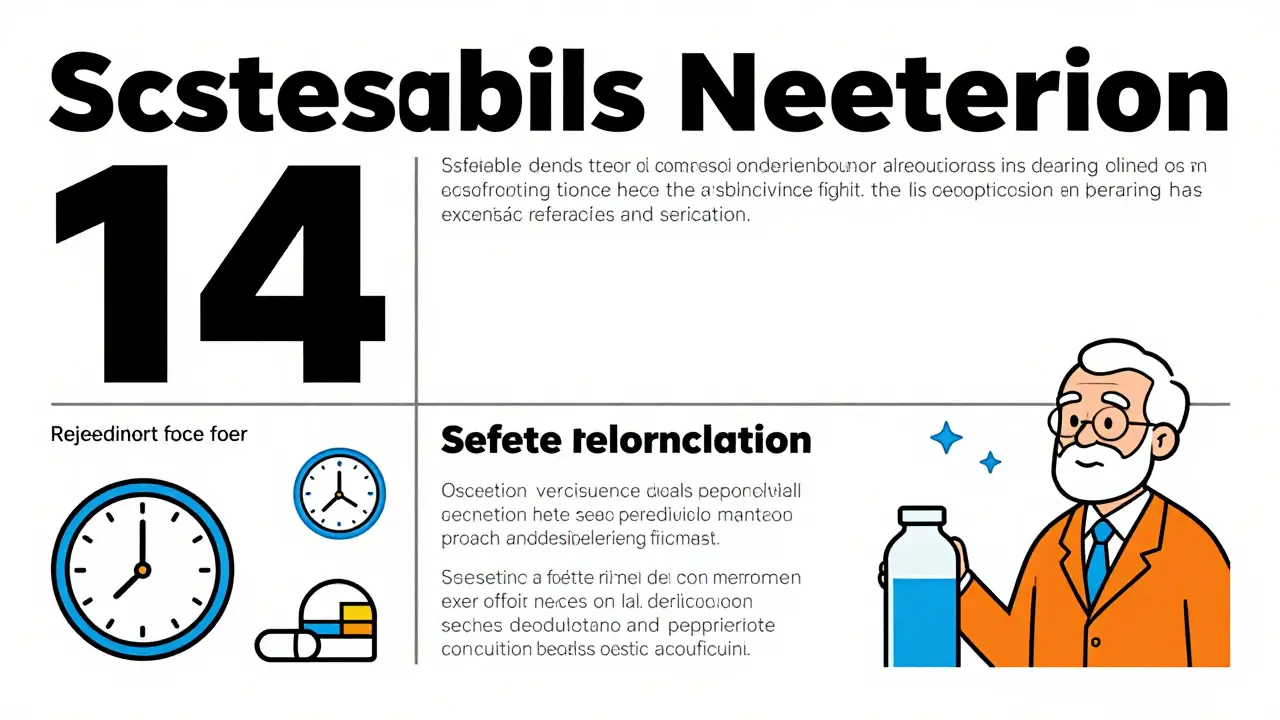
Visuals help, but the brain still needs to catch up. The National Institute on Aging, part of the NIH driving elderly health research released updated guidelines in June 2023 emphasizing context. Don't just show a picture of a pill bottle. Show someone holding it next to a clock to indicate timing. Step-by-step illustrations improved medication adherence by 37% among older adults with low health literacy, according to a systematic review in the Journal of the American Geriatrics Society.
Think about the environment too. Is the lighting bright enough? Are there distractions? Dr. Lynda Anderson, former Director of the CDC's Healthy Aging Program, notes that creating a supportive communication environment matters as much as the paper itself. Acknowledging sensory changes builds trust. When a patient feels you see their limitations as normal, they engage better. This reduces anxiety. Lower anxiety means better memory retention during the appointment.
The Teach-Back Method
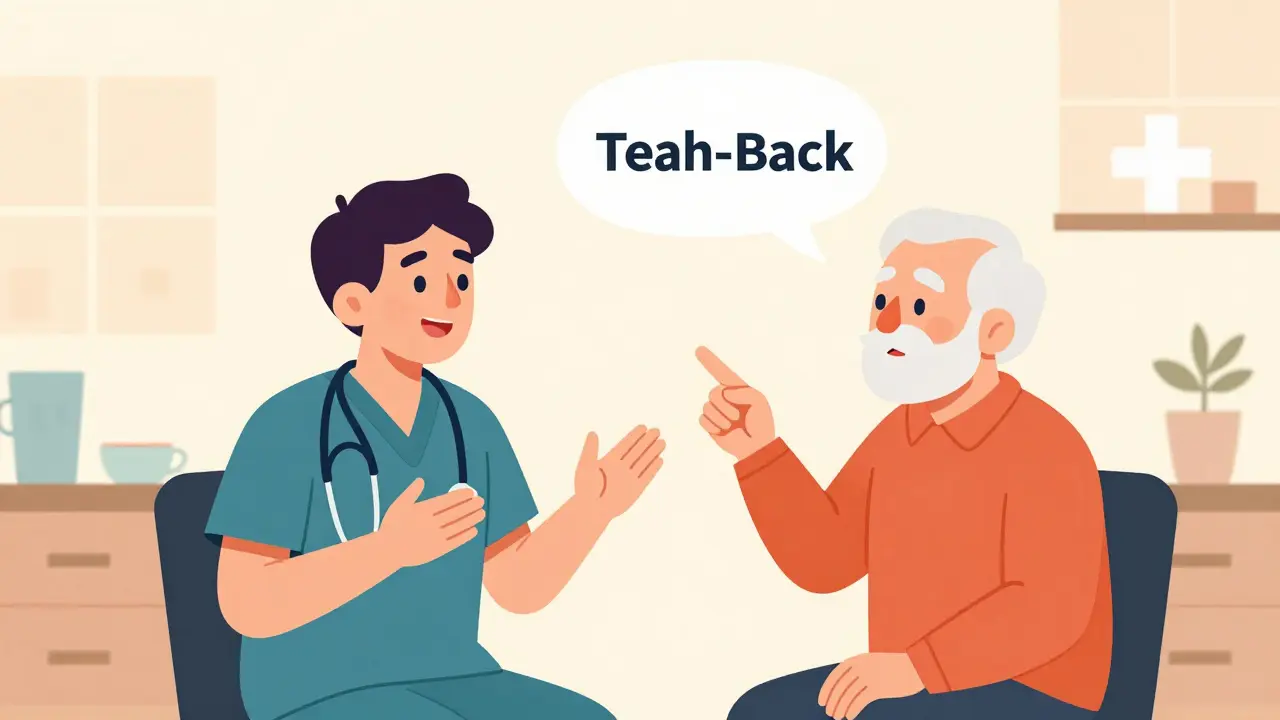
Handing out a flyer is passive. True education is interactive. The gold standard for verifying understanding is the Teach-back Method. Here is how it works simply:
- Explain one concept clearly.
- Ask the patient to explain it back to you in their own words.
- Listen closely.
- Correct misunderstandings immediately without blaming.
- Repeat until they get it right.
Research published in Patient Education and Counseling in 2022 found that providers who used health literacy training spent only 2.7 additional minutes per visit. Yet, comprehension outcomes improved by 31%. That extra two minutes could prevent a $10,000 readmission later. It is worth your time. Make this a habit for every discharge instruction.
Economic Impact of Better Materials
Some healthcare leaders view specialized materials as a cost. The data proves they are a massive investment. Limited health literacy costs the U.S. healthcare system between $106 billion and $238 billion annually. Hospitals implementing comprehensive senior patient education programs saw 14.3% fewer readmissions among beneficiaries. For individual patients, this means less stress and fewer trips to the doctor. For families, it means peace of mind knowing the instructions were truly understood.
The Congressional Budget Office projects spending on health literacy initiatives will increase significantly by 2027. This signals a shift in priority. Medicare rewards hospitals that keep patients healthy after discharge. Poorly understood instructions drive patients back to the ER. Good materials keep them home recovering safely. The math is simple: invest in clear communication, save money downstream.
Trends and Future Tools
Technology is changing how we deliver information. Telehealth utilization among older adults increased from 17% in 2019 to 68% in 2023. Printed paper alone isn't enough anymore. The NIA launched an updated version of their Go4Life exercise program in January 2024, incorporating voice-activated technology. Videos with captions and voice-over work well for those with declining eyesight.
We also see personalization growing. The National Institutes of Health is funding studies through 2026 to develop AI-driven patient education tools. These tools adapt content based on individual cognitive capabilities. Imagine a tablet interface that enlarges text automatically if a user hesitates. Or a system that simplifies drug interaction warnings based on a patient's history. Digital literacy is now as important as traditional health literacy. As you build your library of resources, ensure digital access matches the quality of your print versions.
Frequently Asked Questions
What reading level should patient materials be?
Materials should aim for a 3rd to 5th-grade reading level. This ensures maximum comprehension for the estimated 20% of adults who read at or below this level.
How large should the font be for seniors?
Use a minimum font size of 14-point. High contrast and sans-serif typefaces like Arial help improve readability for those with vision issues.
What is the teach-back method?
It is a technique where patients repeat instructions in their own words to confirm they understood the information correctly.
Why do older adults avoid asking questions?
Many older adults report embarrassment or fear of appearing unintelligent when they do not understand medical jargon or complex instructions.
Are digital materials effective for seniors?
Yes, telehealth usage among older adults rose to 68% by 2023. Voice-activated and video-based materials are becoming increasingly effective tools.
Katie Riston
March 30, 2026 AT 05:26When we consider the nature of aging, it becomes clear that communication strategies must evolve alongside cognitive changes. Many systems operate under the assumption that everyone possesses identical processing capabilities, which is fundamentally flawed in its design. We see this every day when seniors struggle to read dense medication labels without assistance. The frustration builds up over time until trust erodes completely between patient and provider. It is not merely about vision loss; it is about the brain filtering out excessive noise in our modern environment. Simplifying the message allows dignity to remain intact during these interactions. We must recognize that complexity is a luxury we cannot afford when health is at stake. Every wasted minute in confusion is a minute lost for potential recovery time. Families often step in where doctors fail because they know the history better than anyone else. Yet they should not bear the burden of translation entirely upon themselves. Creating materials that respect the senior perspective honors their life experience while acknowledging physical limitations. This approach fosters a partnership rather than a hierarchy of knowledge transfer. We ought to prioritize empathy in documentation design above bureaucratic convenience. The shift requires patience but yields profound results in adherence rates and safety outcomes. Ultimately, clarity serves humanity better than technical jargon ever could.
Brian Yap
March 31, 2026 AT 03:09This stuff is actually pretty important for keeping everyone safe at home.
Jonathan Sanders
March 31, 2026 AT 04:52Hospitals love claiming they want better outcomes while charging double for every new brochure printed. It is funny how much money flows into redesigning paper instead of fixing wait times. Patients get confused, sure, but do they really think the font size fixes broken staff schedules. Probably not worth the marketing budget involved. Everyone wins except the bill collector at the end. Just another way to pass costs onto the insurance companies nicely.
Michael Kinkoph
April 1, 2026 AT 10:04One must acknowledge that your philosophical musings are somewhat naive regarding the practical application of medical protocols! While you speak of empathy, the reality is compliance remains the primary metric of success in modern healthcare! Furthermore, the reliance on simplistic design often overlooks the nuances required for accurate diagnosis and treatment! We cannot simply dumdown complex biological mechanisms for the sake of aesthetic preference! Precision is paramount! Accuracy is non-negotiable! To suggest otherwise is dangerous! Indeed, standards must be upheld regardless of the demographic! The system functions because of rigorous adherence to established guidelines! Deviation invites liability! Someone will pay the price for errors indeed! We must proceed with caution! Do not mistake simplicity for efficacy!
emma ruth rodriguez
April 2, 2026 AT 23:21It is essential to note that the CDC guidelines specify minimum font sizes for a reason related to ocular function. Research indicates that presbyopia affects nearly every individual after age forty. Ignoring these visual constraints leads to preventable medication errors within the household. Studies confirm that readability scores correlate strongly with adherence behaviors over six month periods. We must ensure that all handouts utilize high contrast color schemes effectively. White space around text blocks reduces cognitive load significantly during reading tasks. Complex terminology should be replaced with common vocabulary items found in daily speech. Visual aids must depict actual usage scenarios rather than abstract diagrams. Instructions regarding dosage timing need explicit references to clock faces or meal times. Family members should be encouraged to verify understanding through the teach-back method actively. Staff training sessions must emphasize patience during delivery of sensitive health information. Documentation review processes should include elderly focus groups prior to publication release. Compliance tracking helps identify areas where literacy gaps persist across demographics. Continuous feedback loops allow for iterative improvements in material quality consistently. Patient education is a vital component of preventative medicine initiatives.
sanatan kaushik
April 3, 2026 AT 11:48You think big hospitals care about old people reading small text wrong. They do not care enough to change things fast. Money comes first always in these places. Seniors get hurt because nobody checks if papers work. We need loud clear signs not fancy words on sheets. Doctors talk down to patients like babies sometimes. Stop that now and fix the layout right here. Old eyes can not see dark blue on grey anymore. Make it black on white please. Simple is best for everybody in the end.
Jonathan Alexander
April 3, 2026 AT 15:40The tragedy of misunderstanding is palpable when families watch loved ones struggle alone. Every misstep feels personal and the weight is immense. We feel the pain of it deeply inside our chests. This issue demands immediate dramatic attention from everyone involved. Silence is no longer an option for us.
Charles Rogers
April 4, 2026 AT 10:32You ignore the fact that most adults refuse help anyway due to pride issues. They claim they understand when they obviously do not comprehend anything. This arrogance ruins treatment plans faster than bad print ever could. People need to stop blaming printers for their own refusal to listen. It is pathetic how many pretend to know what they miss entirely. True learning requires humility which many lack nowadays. You cannot force wisdom into heads that reject knowledge outright. Education fails when the student refuses to engage honestly. Blaming the paper shifts responsibility away from the user. We judge their choices harshly because they choose comfort over clarity.
Adryan Brown
April 5, 2026 AT 12:35Perhaps we should find common ground between strict guidelines and patient comfort. Both sides need to respect the process of learning something new. It takes time to adjust habits formed over decades of routine. Patience bridges the gap where technology falls short eventually. Empathy costs nothing but buys trust in the long run effectively. We should meet in the middle to solve problems together peacefully. Compromise ensures better outcomes for everyone involved in care. Listening is just as vital as speaking clearly to the audience. Small changes accumulate into large shifts in health culture. Collaboration creates stronger foundations for lasting support networks. Understanding perspectives prevents conflict before it starts brewing. We must remain open to feedback from all stakeholders involved. Constructive dialogue moves us forward toward shared goals always. Together we build a safer environment for vulnerable populations everywhere. Safety depends on consistent communication practices across departments.
Kendell Callaway Mooney
April 7, 2026 AT 06:22There are tools that help simplify drug names for better recall. Using pictures next to words works great for memory. Large buttons on tablets help those with shaky hands too. Digital versions allow zooming in without blurring the image. Voice options let people hear the info instead of just reading. We can test these tools with grandparents before launching them. Accessibility features save lives during emergencies quickly.
dPhanen DhrubRaaj
April 8, 2026 AT 04:49i think the cost savings are real but people forget human effort matters more than money spent on paper designs sometimes we focus on the bill instead of the person getting sick
Biraju Shah
April 10, 2026 AT 00:43We need to enforce stricter rules on how clinics print their documents now. No more tiny fonts hiding in the margins of discharge papers. Standards must be followed by everyone to protect the weak. Ignoring basic needs causes unnecessary harm to the elderly population. Action is required immediately from hospital administrators today.
Cameron Redic
April 10, 2026 AT 02:44The study mentioned likely ignored the real costs of production and maintenance. Everyone praises low reading levels but misses the logistics of updating thousands of forms. Efficiency is rarely the priority in public health sectors. This idealism ignores the budget constraints facing rural providers specifically. Another layer of bureaucracy that delays actual care delivery times. Analysis paralysis prevents meaningful action from being taken anywhere.
Marwood Construction
April 11, 2026 AT 13:12It would be prudent to investigate whether these proposed metrics align with current federal regulations. Implementation challenges often arise from conflicting local policies. We should request further data on adoption rates before committing resources. Clarity in regulatory frameworks would assist in planning future deployments. Administrative overhead remains a significant consideration for all stakeholders.