
Steroid-Induced Osteoporosis Risk Calculator
Understanding Your Risk
This tool estimates your fracture risk from long-term steroid treatment based on key factors. It's designed to help you discuss appropriate bone protection with your doctor.
Your Fracture Risk Assessment
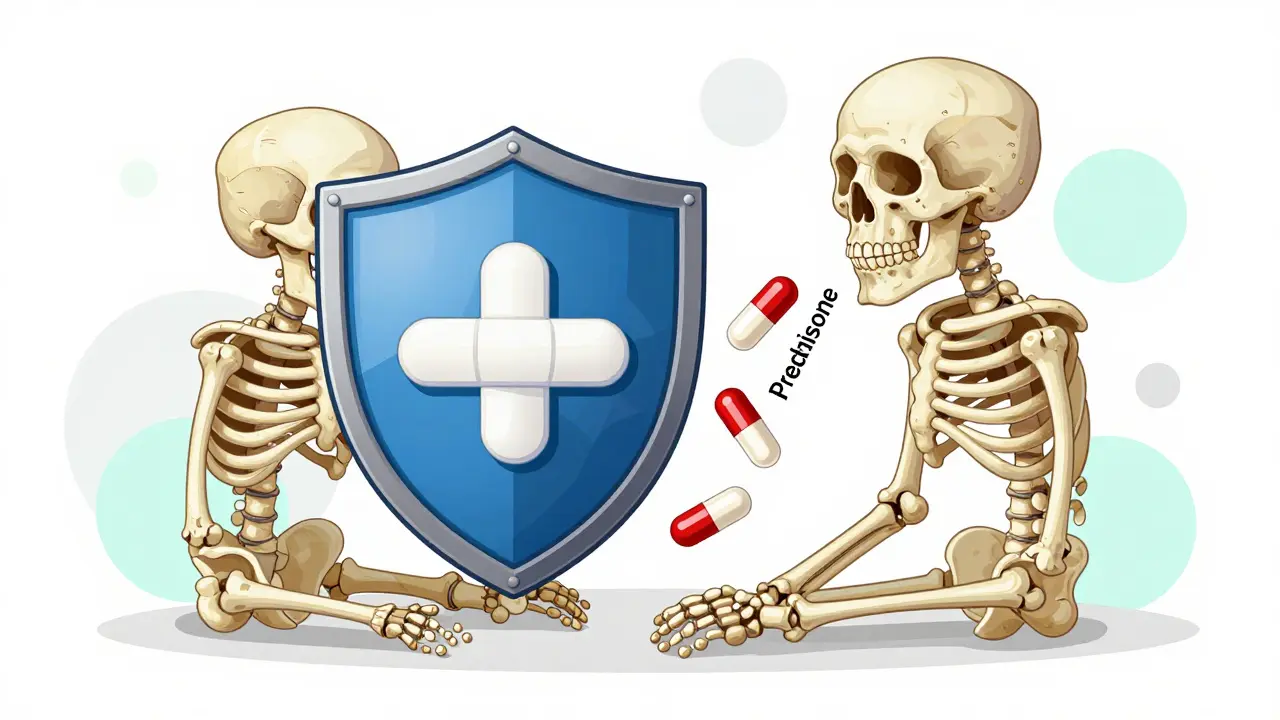
When you’re on long-term steroid treatment - whether for asthma, rheumatoid arthritis, lupus, or another autoimmune condition - your bones pay a hidden price. Even if you feel fine, your bone density may be slipping away. This isn’t just about aging. It’s called glucocorticoid-induced osteoporosis (GIOP), and it’s the most common form of secondary osteoporosis. Studies show that 30% to 50% of people taking daily steroids for more than three months will lose enough bone to increase their fracture risk. That’s not a small number. It’s a silent threat that often goes unchecked.
How Steroids Attack Your Bones
Steroids don’t just calm inflammation. They mess with the natural balance of bone building and breakdown. About 70% of bone loss from steroids comes from shutting down osteoblasts - the cells that build new bone. The rest? They crank up osteoclasts, the cells that break bone down. This double hit starts within the first three to six months of treatment. And it doesn’t wait. At doses of just 5 mg of prednisone daily, fracture risk begins climbing. By year one, about 12% of patients on 7.5 mg or more will have a vertebral fracture.
Compare that to someone not on steroids: your risk of breaking a bone can jump 5 to 17 times higher. That’s why prevention isn’t optional. It’s urgent.
The Foundation: Calcium and Vitamin D
Before you even think about drugs, you need to lay the groundwork. Calcium and vitamin D aren’t just nice-to-haves - they’re non-negotiable. The American College of Rheumatology (ACR) says every patient starting long-term steroids should get:
- 1,000 to 1,200 mg of calcium daily
- 600 to 800 IU of vitamin D daily
If your blood test shows vitamin D levels below 30 ng/mL (deficient), bump that up to 800-1,000 IU. Why? Because without enough vitamin D, your body can’t absorb calcium. And without calcium, your bones have nothing to rebuild with.
Real-world data shows most people don’t get enough from diet alone. One study found that even people taking supplements often fall short. That’s why doctors recommend supplements - not just “eat more dairy.” A daily calcium citrate tablet and a vitamin D3 capsule are simple, cheap, and effective. Skip these, and any other treatment will struggle to work.
Bisphosphonates: The First-Line Shield
If you’re on steroids for three months or more and you’re 40 or older, guidelines say you should be on a bisphosphonate. These drugs - like alendronate (Fosamax), risedronate (Actonel), and zoledronic acid (Reclast) - are the most studied and most used tools to fight steroid-induced bone loss.
Here’s what the data says:
- Alendronate (70 mg weekly) increases spine bone density by 3.7% in one year - while placebo users lose bone.
- Risedronate cuts vertebral fracture risk by 70% (RR 0.30).
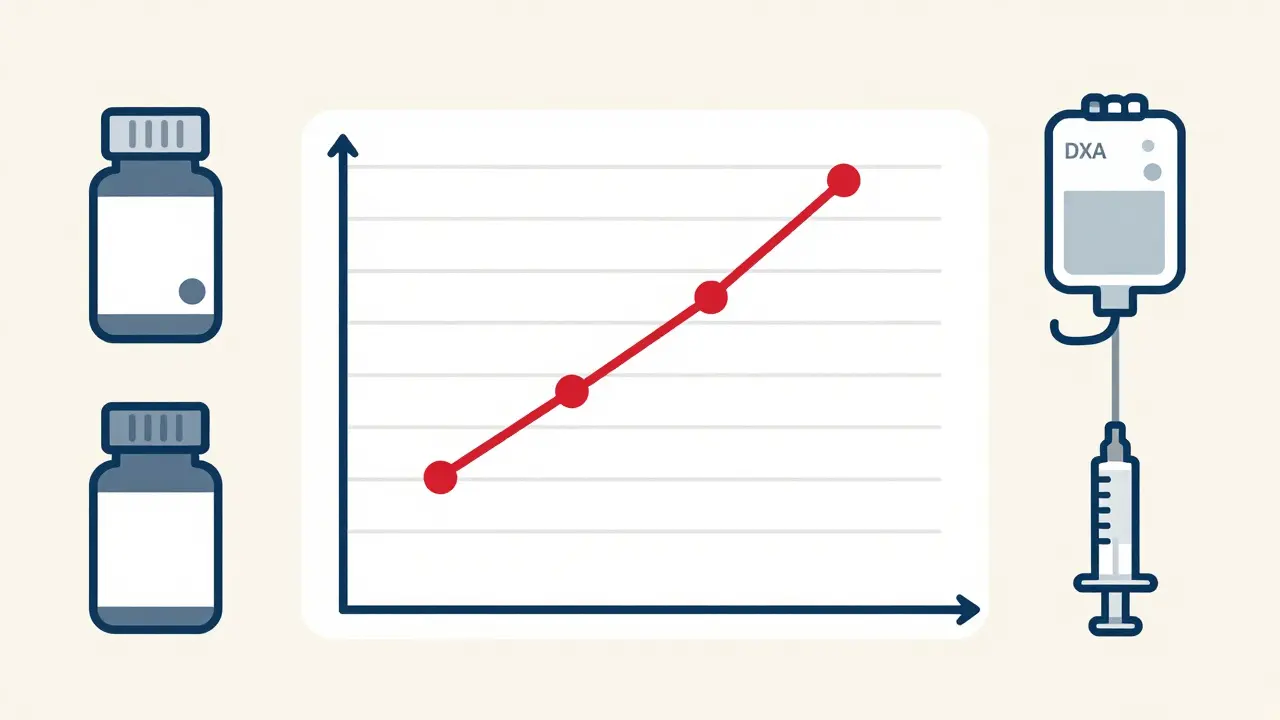
- Zoledronic acid (given once a year by IV) boosts spine density 4.1% more than risedronate over 12 months.
They work by slowing down osteoclasts - the bone-breakers. That gives your body time to rebuild. The Cochrane review of 27 trials found bisphosphonates reduce vertebral fractures by 43%. That’s a huge win.
But they’re not perfect. Oral bisphosphonates require strict rules: take them on an empty stomach, stay upright for 30-60 minutes, and don’t lie down. Why? Because if you don’t, up to 25% of people get esophageal irritation. And about half of patients stop taking them within a year because of side effects or forgetfulness.
That’s why zoledronic acid - the yearly IV infusion - is a game-changer. It skips the stomach, avoids GI issues, and improves adherence. One trial showed 38% better adherence with the yearly shot than with weekly pills.
When Bisphosphonates Aren’t Enough
Not everyone responds the same. If you’re younger than 40 but already had a fracture, or your bone density scan (DXA) shows a T-score below -2.5, or your FRAX score says you have a 20% or higher risk of major fracture - then bisphosphonates alone may not cut it.
That’s where teriparatide (Forteo) comes in. Unlike bisphosphonates, which slow bone loss, teriparatide actually builds new bone. It’s a synthetic version of parathyroid hormone, given as a daily injection under the skin.
The numbers speak for themselves:
- In the ACTIVE study, only 0.6% of patients on teriparatide had new vertebral fractures vs. 6.1% on alendronate.
- Lumbar spine bone density increased 16.2% with teriparatide vs. 4.3% with alendronate over 18 months.
It’s powerful - but expensive. In 2023, a month’s supply cost about $2,500. Generic bisphosphonates? Around $250. And teriparatide has limits: it can’t be used longer than two years, and it’s not safe if you’ve had bone radiation, Paget’s disease, or certain cancers.
Other Options: Denosumab and Newer Drugs
Denosumab (Prolia) is another option, especially if you can’t tolerate bisphosphonates. It’s given as a shot every six months and reduces vertebral fracture risk by 79%. It’s easier than daily pills - but it’s not approved as a first-line option for GIOP in all guidelines. Still, the 2023 ACR update now lists it as an alternative for patients with kidney problems or GI intolerance.
Newer drugs like abaloparatide (Tymlos) - a cousin of teriparatide - showed even better bone gains in trials. The FDA approved it in 2022. But long-term data in steroid users is still limited. For now, bisphosphonates and teriparatide remain the gold standards.
Who Gets Treatment - And Who Doesn’t
Here’s the ugly truth: only about 19% of patients who should be on bone protection actually get it. A study of over 150,000 people found most doctors don’t screen or prescribe. Even when they do, patients often stop. Why? Lack of awareness. Fear of side effects. Confusion over instructions. Cost.
Doctors need to do better. But so do patients. If you’re on steroids, ask:
- Have I had a bone density scan?
- Is my vitamin D level checked?
- Am I on the right medication for my risk level?
Monitoring matters. Get a DXA scan at the start of steroid therapy - then again at 12 months. If bone density drops more than 5%, it’s time to switch or boost treatment.
What About Side Effects?
Yes, bisphosphonates have risks. The FDA has black box warnings for two rare but serious issues: atypical femur fractures and osteonecrosis of the jaw. But here’s the context:
- Atypical fractures: 3 to 50 cases per 100,000 patient-years. That’s rarer than being struck by lightning.
- Osteonecrosis of the jaw: 0.01% to 0.04% in oral users. Mostly in cancer patients on high doses, not typical GIOP users.
The bigger danger? Doing nothing. The risk of a hip or spine fracture from untreated osteoporosis is far greater than these rare side effects. If you’re on steroids long-term, the math is clear: prevention saves more bones than it risks.
Putting It All Together
Here’s what works - step by step:
- Start immediately: As soon as you begin long-term steroids, take calcium (1,000-1,200 mg) and vitamin D (600-1,000 IU) daily.
- Assess your risk: If you’re 40+, on steroids for 3+ months at ≥2.5 mg prednisone daily - start a bisphosphonate.
- Choose wisely: For most, oral alendronate or risedronate is fine. If you can’t swallow pills or have kidney issues, ask about yearly zoledronic acid.
- Upgrade if needed: If you’ve had a fracture or have T-score ≤-2.5, teriparatide is more effective - even if it costs more.
- Monitor: Get a DXA scan at 12 months. If bone loss continues, change tactics.
There’s no one-size-fits-all. But there is a clear path. And it starts with asking the right questions - before your bones break.
Can I just take calcium and vitamin D instead of a bisphosphonate?
Calcium and vitamin D are essential, but they’re not enough on their own if you’re at high risk. Studies show that without a bisphosphonate or other bone-building drug, bone density continues to drop even with supplements. They support treatment - they don’t replace it. The American College of Rheumatology recommends both, but only bisphosphonates (or similar drugs) can reliably prevent fractures in steroid users.
How long should I stay on a bisphosphonate for steroid-induced osteoporosis?
There’s no fixed timeline. Most patients stay on bisphosphonates as long as they’re on steroids - and sometimes longer. After 3-5 years of continuous use, effectiveness may decline. If your steroids are stopped and your bone density stabilizes, your doctor may pause treatment. But if you’re still on steroids, continuing is usually safer than stopping. Always discuss a plan with your doctor.
Are bisphosphonates safe if I have kidney problems?
Oral bisphosphonates are not recommended if your eGFR (kidney function) is below 30 mL/min. For mild to moderate kidney issues (eGFR 30-50), your doctor may reduce the dose - for example, 5 mg daily of alendronate instead of 70 mg weekly. If your kidneys are severely impaired, switch to teriparatide or denosumab, which don’t rely on kidney clearance.
Why is teriparatide better for some people but not everyone?
Teriparatide builds new bone, while bisphosphonates only slow loss. That makes it ideal for people with very low bone density (T-score ≤-2.5), prior fractures, or those who didn’t respond to bisphosphonates. But it’s not for everyone. It requires daily injections, costs 10 times more, and can’t be used longer than two years. It’s also avoided in people with certain bone cancers or radiation history. It’s a powerful tool - but only for specific cases.
What if I forget to take my bisphosphonate pills?
Missing doses reduces effectiveness. Studies show over half of patients stop taking oral bisphosphonates within a year. If you struggle with daily pills, ask your doctor about switching to zoledronic acid - a single yearly IV infusion. It’s just as effective, avoids stomach issues, and eliminates the need to remember daily doses. Adherence improves by 38% with the yearly shot.
Tom Sanders
March 8, 2026 AT 14:28Jazminn Jones
March 9, 2026 AT 10:22Stephen Rudd
March 11, 2026 AT 00:55Erica Santos
March 11, 2026 AT 22:40George Vou
March 13, 2026 AT 06:45Scott Easterling
March 14, 2026 AT 22:00Mantooth Lehto
March 16, 2026 AT 05:20Melba Miller
March 17, 2026 AT 19:36Katy Shamitz
March 19, 2026 AT 09:31