
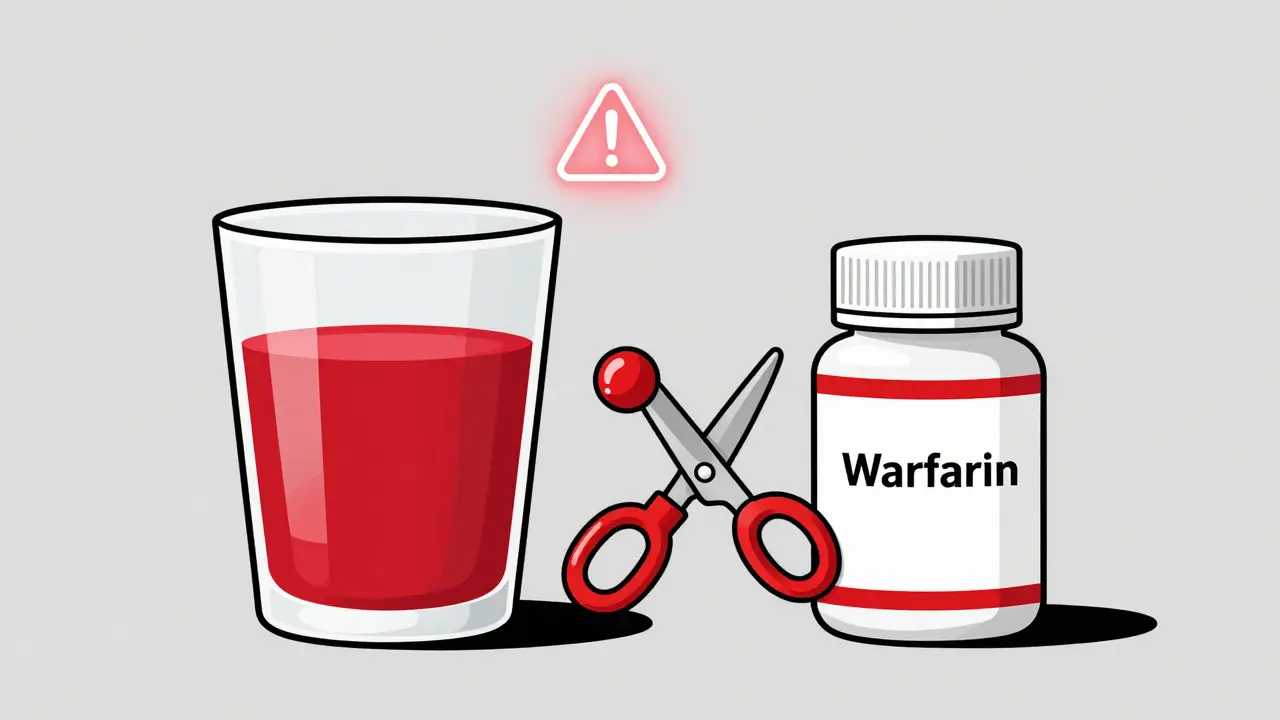
Drinking pomegranate juice is often praised for its antioxidants, heart benefits, and rich flavor. But if you're taking medication, that glass of juice could be more than just a healthy habit-it might be changing how your body handles your pills. This isn't theory. Real people have seen their blood thinner levels spike, their blood pressure drop too low, or their pain meds work too strongly-all after starting regular pomegranate juice. The science behind it is messy, but the risks are real enough to pay attention to.
How Pomegranate Juice Interferes With Your Medications
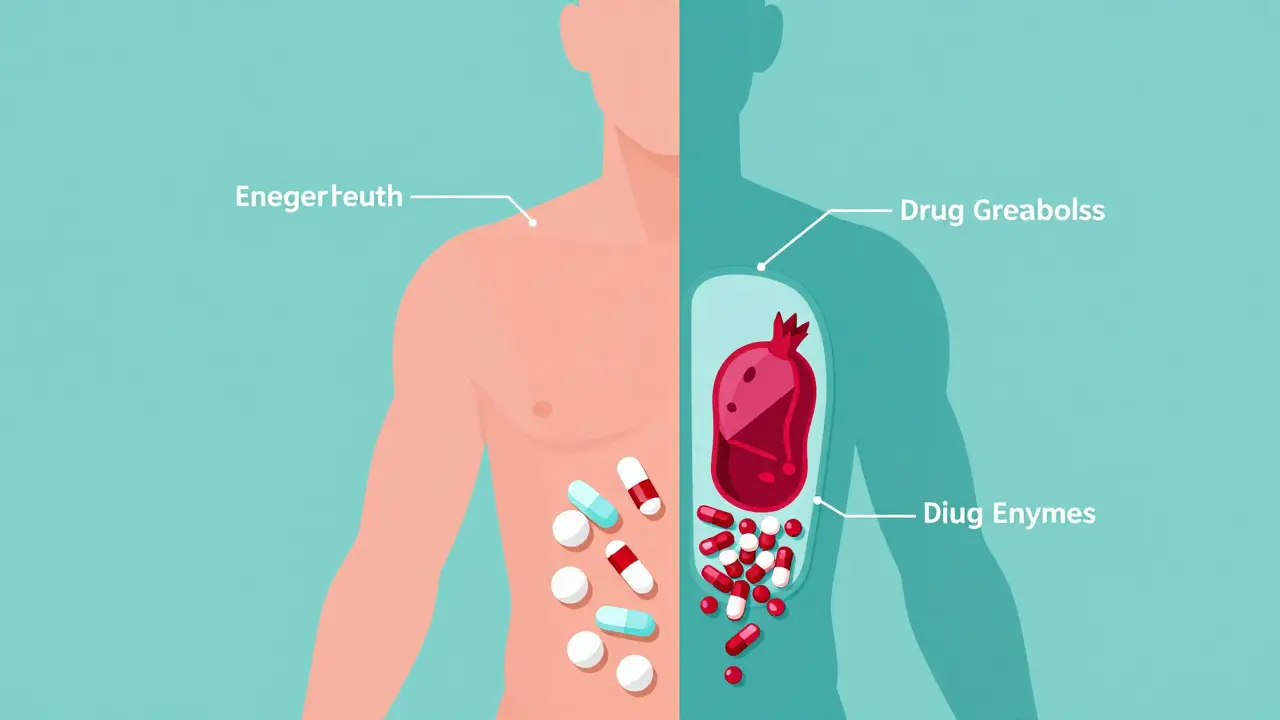
Your body uses enzymes to break down most medications. The main ones are called CYP3A4 and CYP2C9. These enzymes live in your liver and intestines and act like molecular scissors, cutting drugs into pieces so your body can get rid of them. Pomegranate juice contains compounds-punicalagins and ellagitannins-that can slow down these scissors. When that happens, your meds don’t get broken down as fast. That means more of the drug stays in your bloodstream longer.
This isn’t like grapefruit juice, which the FDA warns about clearly. Pomegranate juice doesn’t have the same level of official red flags. But here’s the catch: for certain drugs, even a small change in blood levels can be dangerous. Take warfarin, for example. It’s a blood thinner with a narrow window. Too little, and you risk a clot. Too much, and you could bleed internally. One case reported in 2021 showed a patient’s INR (a measure of blood clotting time) jumping from 2.4 to 4.7 after just three days of daily pomegranate juice. That’s a 96% increase in blood-thinning effect. The patient needed a 30% dose reduction just to get back to safety.
Which Medications Are Most at Risk?
Not all drugs are affected the same way. The biggest concern is with medications that have a narrow therapeutic index-meaning the difference between a helpful dose and a dangerous one is small. These include:
- Warfarin (Coumadin, Jantoven): The most documented risk. Pomegranate juice may increase INR by 0.5 to 1.5 units in some people, pushing levels into dangerous territory.
- Statins like atorvastatin (Lipitor) and simvastatin: Higher blood levels can raise the risk of muscle damage.
- Some antidepressants such as sertraline and escitalopram: Increased levels may cause serotonin syndrome.
- Calcium channel blockers like amlodipine and verapamil: Could lead to low blood pressure or dizziness.
- Immunosuppressants like cyclosporine: Risk of kidney damage or toxicity.
- Some opioids such as fentanyl and oxycodone: May increase sedation or breathing risks.
These aren’t guesses. They’re based on case reports, clinical studies, and pharmacist databases. WebMD lists 17 medications with a “moderate” interaction rating for pomegranate juice. The American Heart Association and Mayo Clinic both flag warfarin as the top concern.
Why the Confusion? Lab Studies vs. Real Life
Here’s where it gets confusing. Test tubes show pomegranate juice can block CYP3A4 by up to 50%. That sounds scary. But when you test it on actual people, results vary wildly.
A 2014 study with 12 healthy volunteers gave them pomegranate juice daily for two weeks and checked how their bodies handled midazolam-a drug known to be broken down by CYP3A4. The result? No change in drug levels. The same study found no effect on another common drug, theophylline. Another trial with rats showed only a 7.2% increase in drug exposure-too small to matter clinically.
So why do some people have bad reactions? The answer might be in the details. Not all pomegranate juices are the same. Some are concentrated. Some are homemade with whole seeds. Some people drink a cup a day. Others sip it every few days. Your genetics might also play a role. Some people naturally have less active CYP enzymes. If you’re one of them, even a small amount of juice could tip the scale.
Dr. David Mischoulon from Massachusetts General Hospital put it bluntly: “Lab results don’t always predict what happens in a person’s body.” That’s why the FDA hasn’t issued a formal warning-unlike with grapefruit juice, which can boost statin levels by up to 15 times.
What Do Experts Actually Recommend?
Most medical groups don’t say “never drink it.” They say: be consistent and watch closely.
- Mayo Clinic advises limiting pomegranate juice to no more than 8 ounces per day if you’re on warfarin, and to drink the same amount every day. Sudden changes-starting or stopping-are riskier than steady use.
- The American Heart Association says consistency matters more than avoidance. Abruptly quitting juice after months of drinking it can cause your INR to drop dangerously low.
- Pharmacists at UNC Eshelman School of Pharmacy suggest waiting at least two hours between taking your medication and drinking the juice. This gives your body time to absorb the drug before the juice hits your system.
- The European Medicines Agency says the risk is low for most drugs-but for warfarin, monitor your INR more often when you start or stop drinking juice.
Bottom line: Don’t panic. Don’t assume it’s safe either. If you’re on a high-risk medication, talk to your doctor or pharmacist before making pomegranate juice part of your routine.
Real People, Real Results
Online communities tell a mixed story. On Reddit’s r/bloodthinners, 17 users reported INR spikes after drinking pomegranate juice. One wrote: “I didn’t think it mattered-until I ended up in the ER.” Another said, “I drank it for years with no issue, then switched brands and my INR jumped.”
But on PatientsLikeMe, out of 214 users taking warfarin who drank pomegranate juice, 89% saw no change in their INR. A 2022 survey of 1,247 patients on chronic meds found only 4.7% had any possible interaction symptoms.
That’s the truth: for most people, it’s fine. For a small group, it’s dangerous. The difference? Genetics, dose, timing, and what else you’re taking. If you’ve been drinking it for years without a problem, you’re probably okay. But if you’re just starting, or if you’ve had a recent change in your meds, proceed with caution.

What Should You Do?
Here’s a simple action plan:
- Check your meds. Look up your prescription on a trusted interaction checker like Mayo Clinic’s or Micromedex. If it lists pomegranate juice as a possible interaction, pay attention.
- Don’t start or stop suddenly. If you want to drink it, start with a small amount (4 oz) and keep it consistent. If you’ve been drinking it, don’t quit cold turkey.
- Time it right. Take your meds at least two hours before or after your juice.
- Monitor. If you’re on warfarin, get your INR checked more often when you start or stop drinking juice.
- Ask your pharmacist. They see drug interactions every day. They’ll know if your specific combo is risky.
There’s no need to give up pomegranate juice if you love it. But treat it like any other variable in your health routine-something to track, not ignore.
What’s Next in Research?
Scientists are still digging. A $487,500 NIH-funded study running through 2024 is testing pomegranate juice’s effects on 12 common drugs in 150 people. Another study is looking at whether genetic differences in CYP enzymes make some people more sensitive than others. Results are expected in 2025.
Until then, the safest approach is simple: know your meds, know your habits, and talk to your care team. Pomegranate juice isn’t the enemy. But pretending it’s harmless when you’re on critical medication? That’s the real risk.
Carolyn Rose Meszaros
January 20, 2026 AT 22:58I’ve been drinking pomegranate juice every morning for years with my blood pressure med, and zero issues. But I also don’t drink the concentrated stuff-just the regular kind from the carton. 🍒✨
Greg Robertson
January 21, 2026 AT 05:49My grandma swore by it for her heart, but she also took warfarin. She never told her doctor, and one day she ended up in the ER with a nosebleed that wouldn’t stop. Lesson learned: talk to your pharmacist. 😅
Crystal August
January 22, 2026 AT 12:13Why are we even talking about this? If you’re on meds, just avoid anything that sounds like it might interfere. Pomegranate juice is just a trendy fad anyway. People treat food like it’s a drug because they don’t trust doctors anymore. 🙄
Nadia Watson
January 22, 2026 AT 23:33As someone who works in public health, I’ve seen too many patients assume natural = safe. This post is incredibly important. Pomegranate juice isn’t inherently dangerous-but when combined with narrow-therapeutic-index drugs, it becomes a silent risk. Consistency, awareness, and communication with your care team are non-negotiable. Please, if you’re on warfarin or statins, don’t wing it. Your liver will thank you. 😊
Courtney Carra
January 23, 2026 AT 01:14It’s funny how we anthropomorphize enzymes like they’re little molecular butlers with scissors, right? But here’s the real question: if the body’s metabolism is so sensitive to a fruit juice, isn’t that a reflection of how fragile our pharmacological interventions really are? We’re patching biology with chemistry, and then wondering why nature fights back. Pomegranate juice isn’t the villain-it’s the mirror. 🤔
clifford hoang
January 23, 2026 AT 09:00Wait… so the FDA doesn’t warn about this, but grapefruit does? Hmm. Coincidence? Or is Big Pharma pushing grapefruit as the scapegoat so they can keep selling pomegranate juice as ‘superfood’ while quietly letting people bleed out? I’ve got 17 friends on blood thinners who all drank pomegranate juice and had ‘unexplained’ INR spikes. They all got ‘lucky’… until they didn’t. 🕵️♂️💊 #CoverUp
Arlene Mathison
January 23, 2026 AT 20:21Just started drinking this juice last week with my statin. I’m monitoring my energy levels and muscle soreness like a hawk. If I feel weird, I’m stopping. No drama. No fear. Just awareness. You don’t have to give up what you love-you just gotta pay attention. 💪🍊
Emily Leigh
January 24, 2026 AT 18:06Ugh. Another ‘be careful’ article. So what? I drink it with my antidepressants and I feel great. My INR? Perfect. My mood? Better. Why are we acting like this is some kind of deadly secret? It’s not. It’s just another fear-mongering headline wrapped in science-speak. 🤷♀️
Art Gar
January 25, 2026 AT 01:32It is imperative that individuals under pharmacological management consult authoritative clinical pharmacology resources prior to the introduction of any phytochemical-rich dietary supplement. The pharmacokinetic modulation of CYP450 isoenzymes by ellagitannins is well-documented in peer-reviewed literature, and the clinical implications are non-trivial. The absence of an FDA warning does not equate to absence of risk. Vigilance is not paranoia-it is responsibility.
Edith Brederode
January 25, 2026 AT 15:09I love this post. So balanced. I’m on cyclosporine after my transplant and I stopped the juice cold turkey after reading this. My pharmacist said I made the right call. Still miss the taste, but my kidney numbers are stable. 🙏
Renee Stringer
January 26, 2026 AT 17:41If you’re on warfarin and you’re still drinking pomegranate juice after reading this, you’re not just being careless-you’re gambling with your life. No emoji, no excuse. Just stop.