

When your body’s hormone levels go off track for no obvious reason - missed periods, unexplained milk production, low libido, or constant fatigue - the culprit might be hiding in a tiny gland at the base of your brain. That’s the pituitary adenoma, a non-cancerous tumor that’s more common than you think. About 1 in 10 people have one, and most never know it. But when it starts pumping out too much hormone, especially a benign tumor in the pituitary gland that overproduces prolactin, the effects hit hard. This is called a prolactinoma, and it’s the most common type of hormone-producing pituitary tumor.
What Exactly Is a Prolactinoma?
Prolactin is a hormone that tells your body to make milk after childbirth. But when a tumor in the pituitary gland starts making too much of it - even when you’re not pregnant - trouble follows. A prolactinoma is a specific kind of pituitary adenoma that overproduces prolactin. It accounts for 40% to 60% of all functional pituitary tumors. These tumors are usually small, under 1 centimeter (microadenomas), but can grow larger (macroadenomas) and press on nearby nerves, especially the optic chiasm, leading to vision problems.
In women, high prolactin levels often mean no periods (amenorrhea), milk leaking from the breasts when not nursing (galactorrhea), or trouble getting pregnant. About 95% of women with prolactinomas experience at least one of these. In men, symptoms are subtler: low sex drive, erectile dysfunction, reduced body hair, and sometimes breast growth. About 80% of men with prolactinomas report sexual issues. Many men don’t connect these symptoms to a brain tumor - they think it’s stress, aging, or depression.
How Do You Know If You Have One?
Diagnosis starts with a blood test. If your prolactin level is above 150 ng/mL, there’s a 95% chance it’s a prolactinoma. Levels over 200 ng/mL usually mean a larger tumor. But don’t jump to conclusions - stress, certain medications (like antidepressants or antinausea pills), and even pregnancy can raise prolactin. That’s why doctors look at more than just the number.
An MRI of the pituitary gland is next. A 3mm slice thickness scan is the gold standard. It shows the size, shape, and whether the tumor is squeezing the optic nerve or spreading into nearby sinuses. If the tumor is bigger than 1 cm, you’ll also need a visual field test. This checks for blind spots in your peripheral vision - a sign the tumor is pressing on the nerves that control sight.
Why Medical Treatment Comes First
For most people, surgery isn’t the first step. The Endocrine Society’s 2022 guidelines say dopamine agonists are the clear winner. These drugs trick the brain into thinking there’s too much prolactin, so the tumor shuts down production. Two drugs are used: cabergoline and bromocriptine.
Cabergoline is the go-to. It’s taken just twice a week - 0.25 mg to 1 mg per dose. Within 3 months, 80% to 90% of small tumors shrink and prolactin levels drop to normal. For larger tumors, the success rate is still 70%. Most patients notice their symptoms improve in 4 to 6 weeks. A 34-year-old woman in a Mayo Clinic case study saw her prolactin level crash from 5,200 ng/mL to 18 ng/mL in six months - and her tumor shrank by 70%.
Bromocriptine works too, but it’s harder to tolerate. Up to 45% of users get severe nausea, and 38% feel dizzy. About 32% quit because of side effects. Only 18% of cabergoline users stop due to discomfort. That’s why doctors start with cabergoline unless there’s a reason not to.

When Surgery Makes Sense
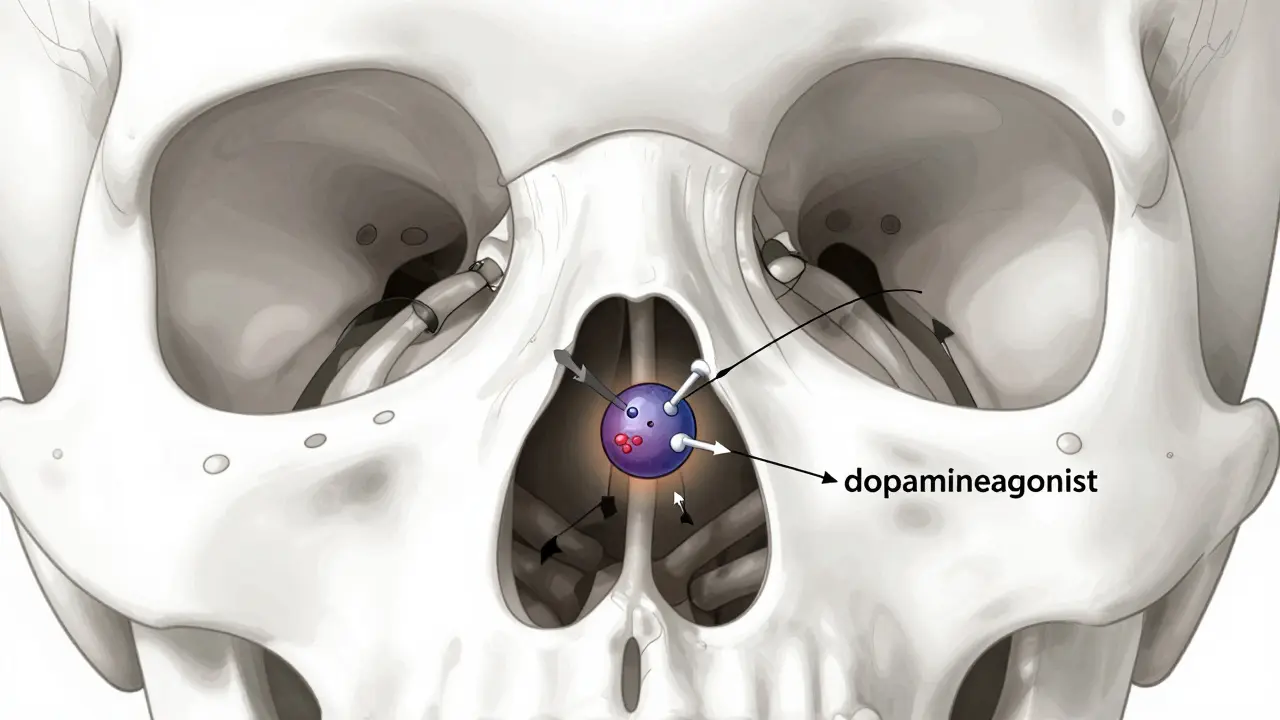
Surgery isn’t a backup - it’s a targeted tool. The transsphenoidal approach - through the nose - is the standard. Endoscopic tools give surgeons a clear view with no facial cuts. For microadenomas, success rates are 85% to 90%. For macroadenomas, it drops to 50% to 60%. Why? Bigger tumors often invade the cavernous sinus, wrapping around major blood vessels. Removing them completely is risky.
Surgery is usually reserved for:
- People who can’t take dopamine agonists due to side effects
- Those with sudden vision loss from tumor pressure
- Patients with a tumor that doesn’t shrink after 6 months of medication
But there are risks. About 5% to 10% get temporary diabetes insipidus (excessive thirst and urination) and need desmopressin. CSF leaks happen in 2% to 5% of cases. Pituitary apoplexy - sudden bleeding into the tumor - is rare but dangerous. Recovery takes 3 to 6 weeks. Most patients report high satisfaction: 82% say the procedure was worth it.
Radiation Therapy: Slow, But Sometimes Necessary
Radiation isn’t a first choice. It takes 2 to 5 years to work. But for tumors that won’t shrink with drugs or surgery - or when surgery isn’t safe - it’s a lifeline. Two main types are used: Gamma Knife radiosurgery and fractionated external beam radiation.
Gamma Knife delivers one high-dose beam with pinpoint accuracy. It controls tumor growth in 95% of cases at five years and causes optic nerve damage in only 1% to 2%. Conventional radiation? That risk jumps to 5% to 10%. But both types can cause the pituitary to stop making other hormones - hypopituitarism. About 30% to 50% of patients develop this within 10 years. That means lifelong hormone replacement for cortisol, thyroid, or sex hormones.
Patients who get radiation often feel frustrated. Sixty-eight percent still have symptoms after one year. But by year three, 85% report improvement. It’s patience, not speed.
What Happens After Treatment?
Even if your prolactin drops and the tumor shrinks, you’re not done. Pituitary tumors need lifelong monitoring. You’ll get blood tests every 3 months at first, then annually if things stay stable. Missing a dose of cabergoline? Prolactin can spike back up in just 72 hours. That’s why adherence is everything.
Long-term cabergoline use (over 2.5 mg per week for more than 3 years) raises a quiet risk: heart valve thickening. The European Society of Endocrinology recommends an echocardiogram every two years if you’re on high doses. The FDA added a black box warning for this reason. Most patients never reach this level, but it’s something to track.
Some people worry about stopping medication. About 70% need to stay on cabergoline forever. If you stop, 50% to 70% relapse within a year. But if your tumor shrinks completely and prolactin stays normal for 2 years, your doctor might try tapering off - carefully.
What’s on the Horizon?
The future of prolactinoma treatment is personal. Researchers are now looking at tumor genetics. Mutations in genes like GNAS and USP8 help predict if a tumor will grow fast or respond well to drugs. In 2023, the FDA approved paltusotine for acromegaly - another pituitary condition - and trials are starting for prolactinomas.
Scientists are also testing dopamine agonist-eluting stents (tiny devices that release drug directly into the tumor) and even CRISPR gene editing to fix mutations behind tumor growth. AI is helping surgeons plan procedures with 3D models of your exact anatomy. These aren’t science fiction - they’re coming fast.
But for now, the rules are simple: get tested if symptoms match. Start with cabergoline. Avoid bromocriptine unless you have to. Monitor closely. And remember - this isn’t a life sentence. Most people return to normal hormone levels, regain fertility, and live full lives.
Can a prolactinoma cause infertility?
Yes. High prolactin blocks the hormones that trigger ovulation in women and sperm production in men. In women, it often causes missed periods and makes pregnancy difficult. In men, it lowers testosterone and reduces sperm count. But the good news? Treatment with cabergoline restores fertility in over 80% of cases within 3 to 6 months.
Is a prolactinoma cancerous?
No. Prolactinomas are almost always benign. They don’t spread to other organs like cancer does. But they can still cause serious problems by pressing on nerves or overproducing hormones. That’s why they need treatment - not because they’re deadly, but because they disrupt your body’s balance.
Why is cabergoline better than bromocriptine?
Cabergoline works longer in the body, so you take it only twice a week. Bromocriptine needs daily dosing and causes more nausea, dizziness, and low blood pressure. Studies show 80% to 90% of patients normalize prolactin with cabergoline, versus 70% to 80% with bromocriptine. Fewer people quit cabergoline because of side effects - only 18% versus 32% for bromocriptine.
Can you get pregnant if you have a prolactinoma?
Yes - once treatment starts. Many women with prolactinomas successfully conceive after starting cabergoline. In fact, doctors often lower the dose during pregnancy to reduce risk. The tumor rarely grows during pregnancy, but monitoring is still needed. Always consult your endocrinologist before trying to conceive.
Do you need surgery if you’re planning to get pregnant?
Usually not. Medication is safer and more effective for fertility. Surgery increases the risk of pituitary damage, which could affect hormone levels during pregnancy. Doctors recommend starting cabergoline, waiting until prolactin normalizes and ovulation resumes, then trying to conceive. Surgery is only considered if the tumor is huge and pressing on vision - which is rare.
What happens if you stop taking cabergoline?
Prolactin levels can rise again within 72 hours. The tumor may start growing back, and symptoms like milk production, missed periods, or low libido return. Stopping without medical supervision is risky. If you want to stop, work with your doctor to test hormone levels and scan the tumor first. Some patients can taper off after years of stability - but only under close watch.
Alexander Pitt
March 19, 2026 AT 22:12MALYN RICABLANCA
March 21, 2026 AT 14:09Aileen Nasywa Shabira
March 22, 2026 AT 12:25Manish Singh
March 23, 2026 AT 02:48Nilesh Khedekar
March 24, 2026 AT 18:03jared baker
March 25, 2026 AT 05:11gemeika hernandez
March 26, 2026 AT 10:20Nicole Blain
March 26, 2026 AT 13:11Kathy Underhill
March 28, 2026 AT 03:01Srividhya Srinivasan
March 29, 2026 AT 10:53Prathamesh Ghodke
March 29, 2026 AT 18:32