
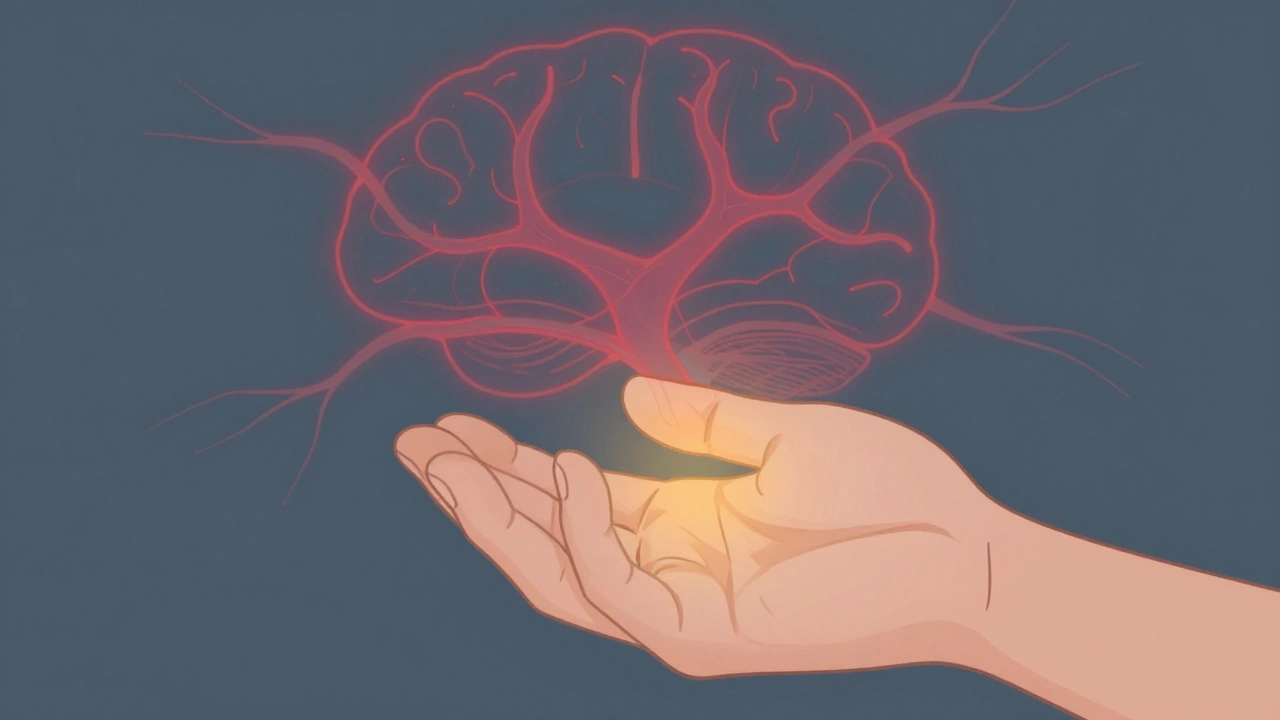
When your hand starts shaking without you meaning it-like you’re rolling a pill between your thumb and finger-that’s often the first sign of Parkinson’s disease. It’s not just shaking. Your muscles feel stiff, like they’re wrapped in rubber bands. Simple things-buttoning a shirt, writing a note, walking-become slow, hard, or even painful. These aren’t just inconveniences. They’re signals that something deep inside your brain is changing.
What’s Really Going On in the Brain?
Parkinson’s isn’t just about shaking. It’s about a quiet, steady loss of dopamine-producing neurons in a small area of the brain called the substantia nigra. By the time symptoms show up, most people have already lost 60 to 80% of those cells. Dopamine is the brain’s movement coordinator. Without enough of it, the circuits that control smooth, automatic motion start to misfire. That’s why movements become stiff, slow, or shaky.The tremor in Parkinson’s is different from the kind you get when you’re nervous or cold. It’s a resting tremor-meaning it happens when your hand is relaxed, not when you’re using it. Most people notice it first in one hand, often on one side of the body. The shaking usually stops when you move your hand or when you’re asleep. Stress, fatigue, or strong emotions can make it worse. About 80% of people with Parkinson’s experience this type of tremor, according to Yale Medicine.
Why Does Stiffness Happen?
Stiffness, or rigidity, affects nearly every person with Parkinson’s. It’s not just tight muscles. It’s your brain losing its ability to relax them properly. During a neurological exam, doctors feel for two types: cogwheel rigidity (like turning a gear) and lead-pipe rigidity (constant resistance, like bending a lead pipe). This stiffness makes everyday tasks frustrating. Writing becomes shaky, buttons won’t snap, shoelaces won’t tie. Parkinson’s UK found that 73% of people struggle with these small movements within just three years of diagnosis.And it’s not just arms and hands. Rigidity can hit your neck, shoulders, or legs. Some people describe it as feeling like they’re moving through thick syrup. It can cause pain, cramps, and even affect posture-making you hunch forward or lose your balance. This isn’t laziness or aging. It’s the brain’s motor system breaking down.
Dopamine Replacement: The Core Treatment
There’s no cure for Parkinson’s. But there’s a treatment that works-dopamine replacement. The most effective way is with levodopa, a chemical your brain can turn into dopamine. Levodopa alone wouldn’t work well-it gets broken down in your body before it reaches the brain. That’s why it’s combined with carbidopa, which blocks that breakdown. Together, they’re sold under names like Sinemet or as generics.When you take levodopa-carbidopa, you usually feel better in 30 to 60 minutes. For many, it’s life-changing. Studies show up to 70% improvement in movement during the first few years-what doctors call the “honeymoon period.” You can walk again. You can write. You can get dressed without help. About 75% of people respond well to this combo, according to the Parkinson’s Foundation.
Why It Doesn’t Last Forever
The problem with levodopa is that it doesn’t fix the disease-it just masks the symptoms. As more dopamine cells die, the brain becomes less able to store and use the drug properly. After 5 to 10 years, many people start having problems:- Wearing-off: The medicine works for only 2 or 3 hours instead of 4 or 5.
- On-off fluctuations: You suddenly switch between moving well (“on”) and being frozen (“off”), with no warning.
- Dyskinesias: Involuntary, dance-like movements-often at the peak of the dose.
These side effects aren’t rare. About 40 to 50% of people on long-term levodopa develop them. One Reddit user, ‘ParkinDad,’ shared: “After 8 years, my ‘on’ time dropped from 6 hours to just 2 or 3. The dyskinesias are worse than the stiffness.”

Alternatives to Levodopa
Not everyone starts with levodopa. For younger patients or those with milder symptoms, doctors sometimes begin with dopamine agonists like pramipexole or ropinirole. These drugs mimic dopamine directly in the brain. They’re about 30 to 50% as effective as levodopa for movement, but they’re less likely to cause dyskinesias early on.One user, ‘SilverLining2022,’ said: “Starting pramipexole at diagnosis kept me stable for five years with almost no side effects.” But these drugs can cause other issues-dizziness, sleepiness, or even compulsive behaviors like gambling or overeating. They’re not a magic fix. Most people eventually need both a dopamine agonist and levodopa. The Cleveland Clinic reports that 60% of patients end up on combination therapy.
Timing, Food, and Daily Life
Taking dopamine meds right isn’t optional-it’s essential. Levodopa competes with protein for absorption in the gut. A big steak or cheese-heavy meal can block it. Many people learn to take their pills 30 to 60 minutes before eating. Others eat low-protein meals at lunch and dinner to keep their meds working.Dosing frequency also changes over time. Early on, you might take it 2 or 3 times a day. Later, you could need 5 or 6 doses. That’s exhausting. The Parkinson’s Foundation found that 78% of patients need help from caregivers to manage their schedule. Time spent managing meds jumps from 15 minutes a day to 45 minutes as the disease advances.
Newer formulations help. Rytary is an extended-release version that lasts longer, cutting daily doses to two. But it costs about $5,800 a year-almost ten times more than the generic. Inbrija, an inhaled form of levodopa, works in 10 minutes for sudden “off” episodes-but it’s $3,700 a month.
What Experts Say About Timing
For years, doctors worried that starting levodopa too early would wear out the brain’s ability to use it. But research now shows that’s not true. The Movement Disorder Society’s 2021 guidelines say levodopa doesn’t speed up Parkinson’s. The real question is: when does the benefit outweigh the risk?Dr. Alberto Espay, a neurologist at the University of Cincinnati, says: “Levodopa remains the most effective treatment-but its long-term side effects often become more disabling than the disease.” That’s why most specialists now use a “start low, go slow” approach. Instead of jumping to 100 mg doses, they begin with 25/100 mg once or twice a day. They watch for side effects and adjust slowly.
Dr. Helen Brontë-Stewart at Stanford adds: “The timing should be based on your life-not a calendar. If you’re still working, driving, or playing with grandkids, you need better control. If symptoms are mild and you’re 55, maybe wait.”

What the Numbers Don’t Tell You
PatientsLikeMe data shows levodopa has an average effectiveness rating of 7.2 out of 10-but side effects score 5.8. Nausea hits 63%. Dizziness, 42%. Dyskinesias, 38%. And 56% of people say timing their meds is the hardest part of daily life.What’s missing from these stats? The emotional toll. The frustration of planning your day around pills. The fear of being stuck in an “off” state during a family dinner or a work meeting. The guilt of needing help. The loneliness of a disease that looks invisible.
What’s Next?
Researchers are working on better ways to deliver dopamine. One promising approach is continuous infusion-through a pump under the skin, like insulin for diabetes. The RESTORE-1 trial showed patients gained 2.5 more “on” hours per day with this method. Gene therapies are being tested too, aiming to make brain cells produce dopamine again. But these are still experimental.The Michael J. Fox Foundation’s PD GENEration study is trying to personalize treatment. Some people have genetic differences in how they break down dopamine. That might explain why one person does great on pramipexole and another has terrible side effects on the same drug. In the future, a simple blood test could tell you which medication to start with.
For now, dopamine replacement remains the best tool we have. It doesn’t stop Parkinson’s. But it gives people back their movement, their dignity, their days. And for many, that’s enough to keep going.
Is Parkinson’s disease the same as essential tremor?
No. Essential tremor is a different condition. It usually affects both hands equally, happens when you’re using them (like holding a cup), and doesn’t cause stiffness or slowness. Parkinson’s tremor is mostly at rest, starts on one side, and comes with other symptoms like rigidity and slow movement. Doctors can tell them apart with a neurological exam.
Can diet affect how well levodopa works?
Yes. Protein-especially from meat, dairy, and eggs-can block levodopa from being absorbed in the gut. Many people take their pills 30 to 60 minutes before meals. Some follow a low-protein diet, saving protein for dinner. Others split protein evenly throughout the day. It’s not about cutting protein entirely, but timing it right. Talk to your doctor or a dietitian who knows Parkinson’s.
Why do I get dizzy after taking my Parkinson’s medication?
Dizziness is common with dopamine medications. Levodopa and dopamine agonists can lower blood pressure, especially when standing up. This is called orthostatic hypotension. To help, drink more water, avoid alcohol, stand up slowly, and wear compression socks. If it’s bad, your doctor might adjust your dose or add a medication like midodrine.
Is it safe to stop dopamine meds suddenly?
Never stop suddenly. Stopping dopamine replacement abruptly can trigger a life-threatening condition called neuroleptic malignant syndrome-fever, confusion, muscle rigidity, and organ failure. Always taper off under a doctor’s supervision, even if you feel worse on the meds.
Do dopamine replacement drugs cure Parkinson’s?
No. They only manage symptoms. Parkinson’s continues to progress as brain cells keep dying. Dopamine meds help you move better, but they don’t stop the underlying damage. That’s why research is focused on neuroprotective therapies-drugs that might slow or stop the disease itself. None are approved yet, but clinical trials are ongoing.
How do I know if my medication dose is right?
Track your “on” and “off” times. Keep a simple log: when you took your pill, when you felt better, when you felt stiff or frozen again. Note any dyskinesias or side effects. Bring this to your neurologist every 3 to 6 months. Good control means at least 75% of your day is “on” with minimal side effects. If you’re spending more than half your day “off,” your regimen needs adjusting.
Final Thoughts
Parkinson’s changes everything-but dopamine replacement gives people back pieces of their lives. It’s not perfect. It’s messy. It requires planning, patience, and sometimes, a lot of trial and error. But for millions, it’s the difference between staying home and going out. Between needing help and doing things yourself. Between despair and hope.The goal isn’t to eliminate every symptom. It’s to find the balance-enough movement to live, without too many side effects to break you. And that balance? It’s different for everyone.
Ben Greening
December 11, 2025 AT 09:54The clarity of this breakdown is remarkable. I’ve seen patients struggle with the timing of levodopa for years, and this nails the practical realities-protein interference, dosing frequency, the emotional toll of planning life around pills. It’s not just medicine; it’s a full-time job.
Neelam Kumari
December 11, 2025 AT 14:12Of course it’s dopamine. Because science always has the answer, right? Meanwhile, the real issue is that Big Pharma’s been selling this placebo for decades while ignoring the root cause-electromagnetic poisoning from 5G towers. You think your tremor’s from dead neurons? Nah. It’s your phone.
Doris Lee
December 13, 2025 AT 02:53This is exactly what my dad needed to hear. Thank you for writing this with so much heart. He’s been feeling invisible, and this? This makes him feel seen.
Queenie Chan
December 14, 2025 AT 04:22I love how you described rigidity as ‘moving through thick syrup’-that’s not just accurate, it’s poetic. I’ve been watching my aunt wrestle with this for seven years, and no doctor ever captured it like that. It’s not stiffness-it’s gravity turning against her. And the part about ‘the guilt of needing help’? That’s the quiet scream no one talks about. The shame of becoming a burden, even when you’re still the same soul inside.
Levodopa isn’t a cure, but it’s a bridge. And bridges don’t have to be perfect to carry you across. I wish more people understood that. We fixate on the side effects, the dyskinesias, the ‘wearing-off’-but we forget the miracle of a hand that can hold a coffee cup again. That’s not chemistry. That’s dignity restored.
And the idea of genetic personalization? That’s the future. Imagine a blood test telling you which drug your brain was built to love. No more trial-and-error hell. Just precision. We’re not far off.
But let’s not romanticize it. Six doses a day. A calendar on the fridge. A spouse who becomes a pharmacist. That’s the real cost. The numbers say 78% need help managing meds-but they don’t say how many caregivers quit their jobs to do it.
I’m not a doctor. I’m just someone who’s sat in too many neurology waiting rooms. And I’ve learned: the most powerful medicine isn’t in the pill. It’s in the person who remembers to ask, ‘How are you today, really?’
Stephanie Maillet
December 15, 2025 AT 16:41There’s something profoundly human here-not just the science, but the silence between the symptoms. The way a tremor doesn’t just shake a hand, but a sense of self. The way a stiff shoulder becomes a metaphor for isolation. We talk about dopamine like it’s a switch, but it’s more like a fading candle-each dose a flicker, each ‘off’ period a deeper shadow.
I’ve always believed that medicine, at its best, doesn’t just treat the body-it honors the person inside it. And this post? It honors them. It doesn’t reduce Parkinson’s to a chemical deficit. It shows the weight of the mornings you can’t button your shirt, the dinners you skip because protein blocks the pill, the fear that your next ‘off’ will come while you’re holding your grandchild’s hand.
And yet-there’s hope. Not in cures, but in moments. In the 2.5 extra ‘on’ hours from a pump. In the quiet pride of tying your own shoes. In the fact that someone, somewhere, wrote this so you don’t feel alone.
Thank you. Truly.
Michaux Hyatt
December 16, 2025 AT 10:08One thing people don’t mention enough: the social isolation. You start avoiding parties because you’re worried about shaking with a drink. You skip family gatherings because you don’t want to explain why you can’t stand up fast. And then you feel guilty for feeling guilty. It’s a double hit.
Also-low-protein dinners? Game changer. My mom switched to tofu stir-fry at night and went from 2 ‘on’ hours to 6. No magic, just math.
Raj Rsvpraj
December 16, 2025 AT 13:44How can you even trust Western medicine when they’ve been pushing levodopa for 60 years and still have no cure? Meanwhile, in India, Ayurveda has been balancing Vata dosha for millennia-herbs like Mucuna pruriens contain natural L-DOPA! But no, you’d rather pay $5,800 for a pill than try centuries of wisdom. Western arrogance at its finest.
Jack Appleby
December 16, 2025 AT 19:20Technically, the substantia nigra doesn’t ‘die’-it undergoes selective neuronal loss due to alpha-synuclein aggregation, mitochondrial dysfunction, and neuroinflammation. Also, ‘dopamine replacement’ is a misnomer; levodopa is a precursor, not dopamine itself. And ‘dyskinesias’ aren’t ‘dance-like’-they’re choreiform, a hyperkinetic movement disorder resulting from pulsatile receptor stimulation. Please consult the Movement Disorder Society’s diagnostic criteria before using pop-sci analogies.
David Palmer
December 17, 2025 AT 18:14Bro, I thought Parkinson’s was just old people shaking. Turns out it’s like your phone battery dying one percent at a time. You’re fine… then suddenly you can’t move. And now you gotta plan your whole life around pills? Sounds like a nightmare.
Nikki Smellie
December 18, 2025 AT 06:32Have you considered that this entire narrative is a distraction? The real cause of Parkinson’s is glyphosate in the food supply-manufactured by Monsanto, now owned by Bayer, who also owns the patents on levodopa. They profit from your dependence. The FDA knows. The WHO knows. But they won’t tell you. That’s why your tremors persist. It’s not the brain-it’s the poison in your kale smoothie.
Frank Nouwens
December 19, 2025 AT 10:58While the clinical descriptions are accurate, the emotional dimension presented here is both underappreciated and profoundly important. The psychological burden of temporal dependency on pharmacological intervention-particularly when it introduces unpredictable motor fluctuations-is a critical, yet rarely quantified, component of disease progression. This perspective should be integrated into medical education.
Kaitlynn nail
December 20, 2025 AT 05:48