
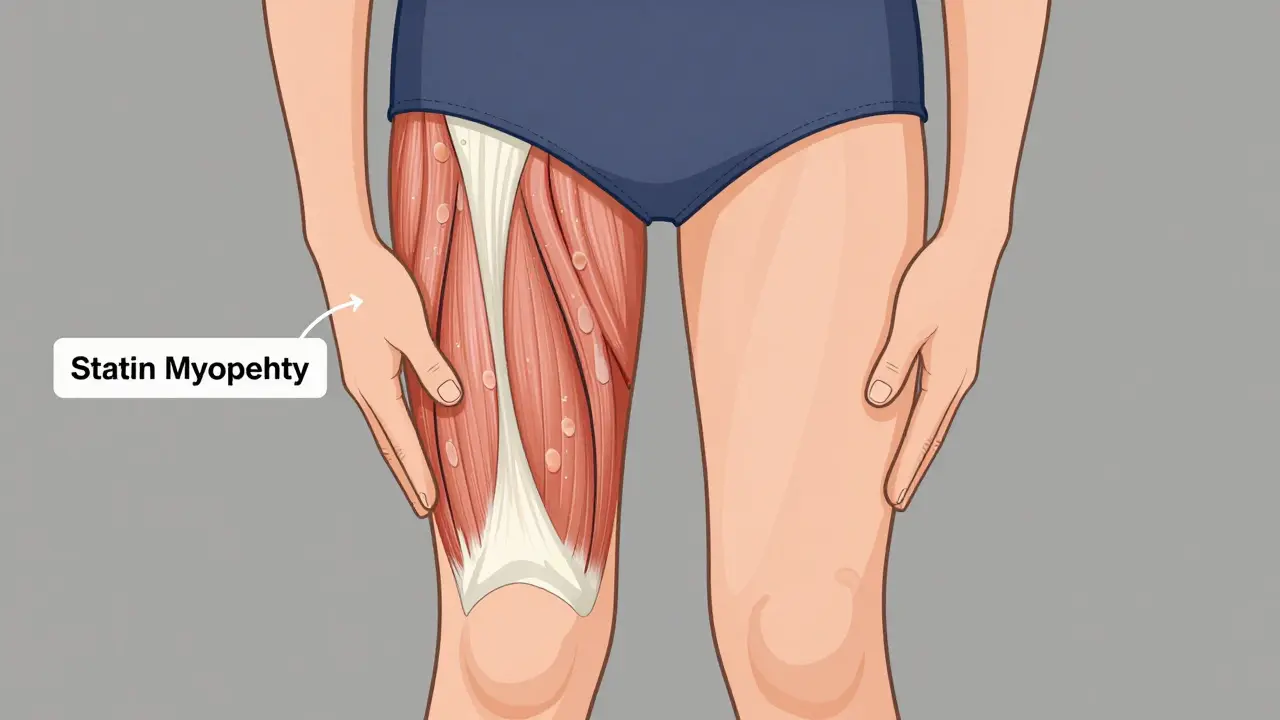
Statin Side Effect Diagnostic Tool
This tool helps you assess whether your muscle symptoms are more likely to be statin myopathy or neuropathy. Remember, only a doctor can make a definitive diagnosis, but this tool can help you better understand your symptoms and prepare for a discussion with your healthcare provider.
Your Symptoms
Results
Enter your symptoms to see if they're more likely to be statin myopathy or neuropathy.
When you start taking a statin to lower your cholesterol, you expect better heart health-not new muscle pain or cramps. But for many people, that’s exactly what happens. Muscle cramps, aches, or weakness show up out of nowhere. And suddenly, you’re stuck: is this just a normal side effect, or something more serious? The truth is, not all muscle problems on statins are the same. Two very different conditions can look alike: statin myopathy and statin-associated neuropathy. Getting this wrong can lead to unnecessary stopping of life-saving medication-or worse, missing a real problem.
What Statin Myopathy Really Feels Like
Statin myopathy is muscle damage caused by the drug itself. It’s not an allergic reaction. It’s not inflammation. It’s a slow, silent breakdown in how your muscles produce energy. The key clue? It hits both sides of your body, usually in the thighs, hips, or shoulders. You might notice it when climbing stairs, getting up from a chair, or lifting your arms. It doesn’t hurt like a pulled muscle. It’s more like constant fatigue, heaviness, or dull aching that doesn’t go away with rest.What makes it tricky is that your creatine kinase (CK) levels-often tested to check for muscle damage-can be normal or only slightly elevated. In fact, most cases of statin myopathy happen without any big spike in CK. That’s why many doctors miss it. Patients think, “My blood test is fine, so it can’t be the statin.” But research shows that up to 29% of people on statins report muscle symptoms in real-world settings, even though clinical trials only report 1-5%. Why the gap? In trials, people are closely monitored. In real life, symptoms get brushed off as aging or being out of shape.
The science behind it is clear: statins block HMG-CoA reductase, an enzyme your liver uses to make cholesterol. But that same enzyme is also needed in your muscles to make coenzyme Q10 (CoQ10), which powers your mitochondria-the energy factories inside your cells. Within 30 days of starting a statin, CoQ10 levels in muscle tissue can drop by 40%. That’s like turning down the fuel to your muscles. Add to that disrupted calcium balance and impaired protein repair, and your muscles start to struggle. Studies in mice with muscle-specific statin effects showed exactly this: mitochondrial failure, muscle cell death, and elevated CK.
Who’s at higher risk? Women over 65. People taking statins with fibrates like gemfibrozil. Those with the HLA-DRB1*11:01 gene variant. And anyone who’s been on a high-dose statin for over a year. The European Atherosclerosis Society says true myopathy with CK more than four times the upper limit is rare-about 1 in 10,000 per year-but milder forms are common.
Neuropathy on Statins: The Nerve Problem Nobody Talks About
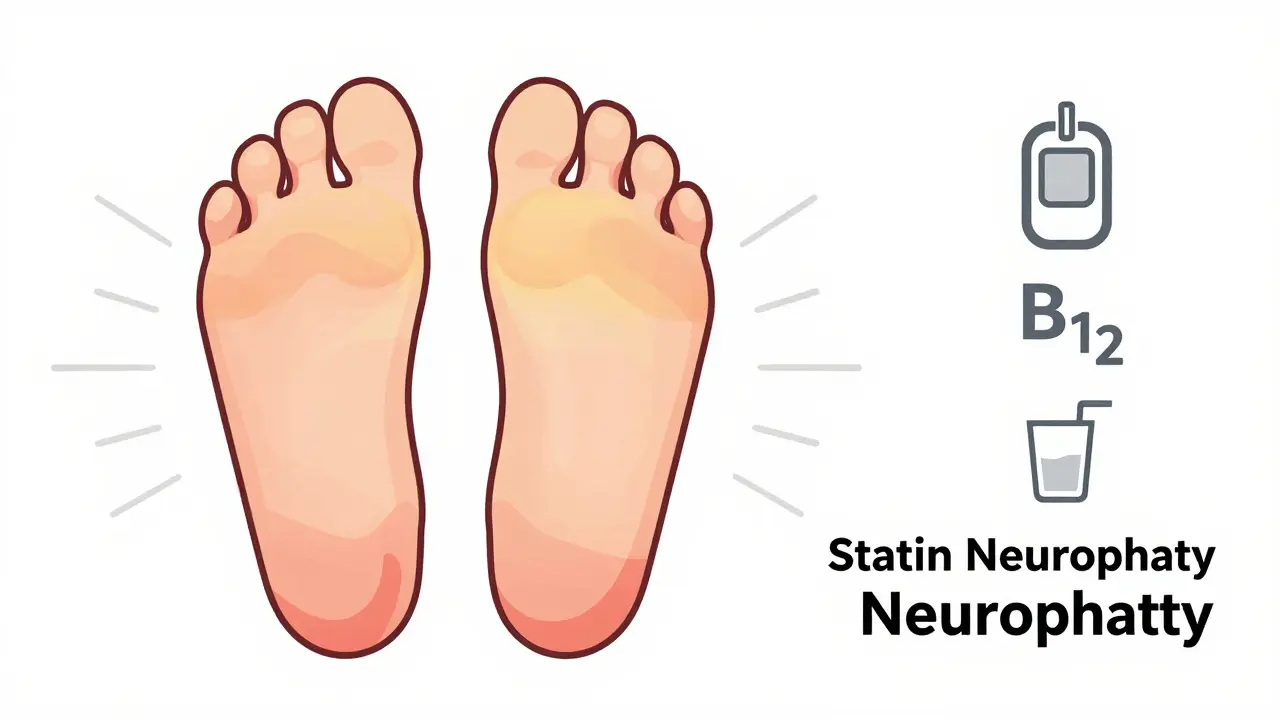
Now, here’s where things get confusing. Some people on statins report tingling, burning, or numbness in their feet or hands. It feels like pins and needles, especially at night. The sensation spreads like socks or gloves being pulled on. That’s not muscle weakness-it’s nerve trouble. This is peripheral neuropathy.But here’s the twist: the evidence linking statins to neuropathy is all over the place. Some studies say statins increase the risk. Others say they lower it. A 2019 case-control study of 616 patients found that those on statins had a 50% lower chance of developing polyneuropathy. Another study suggested statins might even protect nerves by reducing inflammation. So why do some patients swear their symptoms started with the statin?
The proposed mechanisms are speculative but plausible. Cholesterol is a key part of nerve cell membranes. Lowering it too much might make nerves less stable. Statins also reduce LDL, which carries vitamin E-a powerful antioxidant for nerves. Less vitamin E could mean more nerve damage over time. And again, CoQ10 depletion might affect nerve energy production, since nerves are energy-hungry tissues.
But here’s the catch: peripheral neuropathy has many common causes. Diabetes. Vitamin B12 deficiency. Alcohol use. Hypothyroidism. Autoimmune disorders. If you’re over 50 and have neuropathy, there’s a good chance one of these is the real culprit-not the statin. That’s why experts say: don’t jump to stop your statin just because your feet are tingling. Rule out the usual suspects first.
How to Tell Them Apart: The Quick Diagnostic Guide
You can’t rely on symptoms alone. You need to compare the pattern, the tests, and the timeline.- Location: Myopathy = proximal muscles (hips, thighs, shoulders). Neuropathy = distal limbs (feet, hands).
- Sensation: Myopathy = weakness, heaviness, aching. Neuropathy = tingling, burning, numbness, electric shocks.
- CK Levels: Myopathy = normal or mildly elevated (sometimes >4x ULN). Neuropathy = always normal.
- Electrodiagnostic Tests: Myopathy = EMG may show myopathic patterns (small, short motor units). Neuropathy = nerve conduction studies show reduced sensory nerve signals, especially in axonal damage.
- Response to Stopping: Myopathy = symptoms improve within weeks to months after stopping statin. Neuropathy = may not improve, or may worsen if the real cause (like diabetes) is untreated.
One real-world case from 2023 described a 72-year-old woman on atorvastatin who developed sudden leg weakness and difficulty walking. Her CK was only slightly up. She was misdiagnosed with Guillain-Barré syndrome-until her neurologist noticed the pattern: symmetric, proximal, no sensory loss. She stopped the statin. Within six weeks, she could climb stairs again. That’s myopathy.
Another patient, a 68-year-old man with type 2 diabetes, developed burning feet six months after starting rosuvastatin. His CK was normal. His nerve tests confirmed axonal neuropathy. His A1C was 8.2%. He didn’t need to stop the statin-he needed better blood sugar control.
What to Do If You Have Symptoms
If you’re on a statin and notice new muscle or nerve symptoms, don’t panic. But don’t ignore it either.- Track your symptoms. When did they start? Did they begin within weeks of starting the statin or changing the dose? Do they get worse with activity? Are they worse on one side or both?
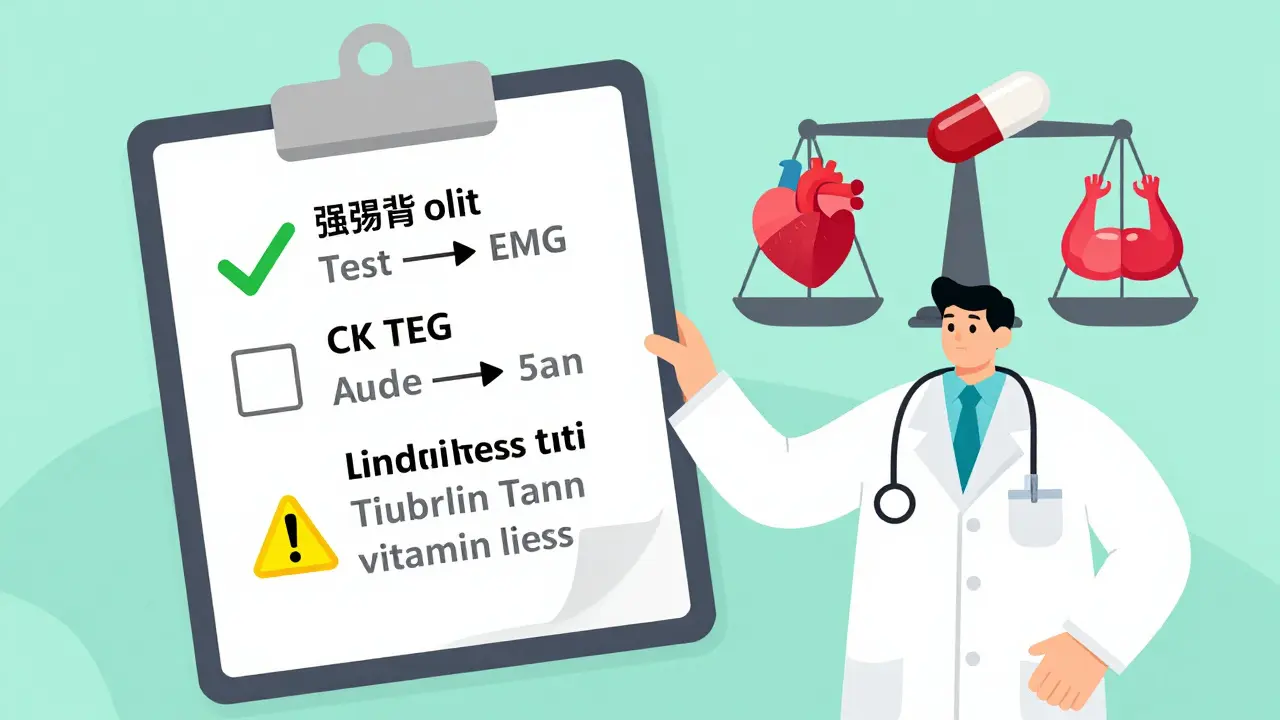
- Get a CK test. Even if it’s normal, it’s a baseline. Repeat it if symptoms worsen.
- Check for other causes. Ask your doctor to test your thyroid, vitamin B12, HbA1c, and alcohol use. These are far more common causes of muscle and nerve problems than statins.
- Consider an EMG/NCS. If symptoms suggest nerve damage, a neurologist should order nerve conduction studies and electromyography. This is the only way to confirm neuropathy.
- Don’t stop the statin on your own. Stopping without a plan increases your risk of heart attack or stroke. The Cholesterol Treatment Trialists’ meta-analysis showed that every 1 mmol/L drop in LDL reduces major heart events by 25%.
If myopathy is confirmed, you don’t have to give up on cholesterol control. The European Atherosclerosis Society recommends switching to a different statin-especially hydrophilic ones like pravastatin or rosuvastatin, which are less likely to enter muscle cells. About 60% of people who had myopathy with one statin tolerate another. You can also add ezetimibe or a PCSK9 inhibitor to keep LDL low without the statin dose.
CoQ10 Supplements: Do They Help?
You’ve probably seen ads for CoQ10 supplements to “fix statin muscle pain.” It sounds logical-statins lower CoQ10, so take more back. But the science doesn’t back it up. A 2015 JAMA study of 44 statin-intolerant patients found no difference in muscle pain between those taking CoQ10 and those taking a placebo. Other studies show similar results. That doesn’t mean it doesn’t help anyone-but it’s not a reliable fix. Don’t spend money on it expecting miracles.The Bigger Picture: Don’t Let Fear Stop Your Heart Protection
Statin myopathy is real. Statin neuropathy is uncertain. But both are rare compared to the proven benefits. For people with heart disease, diabetes, or high cholesterol, the risk of not taking a statin is far greater than the risk of muscle side effects. In fact, the number of heart attacks prevented by statins far outweighs the number of muscle problems caused.What matters is smart management. Work with your doctor. Get the right tests. Don’t assume every ache is the statin. Don’t assume every tingling is nerve damage. Use evidence, not guesswork. And if you do need to change your medication, there are other powerful options that still protect your heart.
Statin therapy isn’t perfect. But it’s one of the most effective tools we have. The goal isn’t to avoid side effects at all costs-it’s to manage them wisely so you can keep living well.
Can statins cause permanent muscle damage?
In most cases, no. Statin-associated myopathy is reversible. Muscle strength and symptoms usually improve within weeks to months after stopping the statin. Rarely, if muscle damage is severe and prolonged (like in immune-mediated necrotizing myopathy), recovery can take longer and may require additional treatment like immunosuppressants. But permanent damage from typical statin myopathy is extremely uncommon.
Is it safe to restart a statin after stopping due to muscle cramps?
Yes, in many cases. About 60% of people who had muscle symptoms on one statin can tolerate a different one, especially hydrophilic statins like pravastatin or rosuvastatin. Starting at a low dose and slowly increasing helps. Some doctors also recommend taking the statin every other day. Never restart without medical supervision.
Do all statins cause muscle problems equally?
No. Lipophilic statins like simvastatin and atorvastatin enter muscle cells more easily and are linked to higher rates of myopathy. Hydrophilic statins like pravastatin and rosuvastatin are less likely to cause muscle issues. Dose matters too-80 mg of simvastatin carries much higher risk than 10 mg of rosuvastatin.
Can statins cause neuropathy in people without diabetes?
It’s possible, but not proven. Some patients report nerve symptoms after starting statins, even without diabetes. However, large studies haven’t confirmed a direct link. If you develop neuropathy and don’t have diabetes or other known causes, your doctor should investigate other possibilities before blaming the statin. Statins may even reduce neuropathy risk in some cases.
Should I get genetic testing if I have muscle pain on statins?
Genetic testing for SLCO1B1 is available and can show if you’re at higher risk for simvastatin-induced myopathy-especially at high doses. But it’s not routinely recommended unless you’ve had severe muscle problems or are considering restarting a statin after a bad reaction. It’s expensive and not always covered by insurance. For most people, clinical evaluation and trial-and-error with different statins are more practical.
Frank Geurts
January 16, 2026 AT 05:40Statin myopathy is a well-documented, biologically plausible phenomenon-CoQ10 depletion, mitochondrial dysfunction, and altered calcium homeostasis are all mechanistically sound. The fact that CK levels are often normal does not invalidate the clinical reality; it merely reflects the limitations of current biomarkers. We must stop conflating statistical rarity with clinical insignificance.
Arjun Seth
January 17, 2026 AT 23:45People these days blame everything on pills. I’ve been on statins for 10 years, never had a problem. If you’re weak, it’s because you sit on the couch all day. Get up. Move. Stop looking for excuses. The system is rigged to make you dependent on drugs.
Ayush Pareek
January 18, 2026 AT 00:31I appreciate how thorough this breakdown is. My mom had cramps on simvastatin and switched to pravastatin-within a month, she was hiking again. It’s not about avoiding statins, it’s about finding the right fit. Don’t give up on heart health just because one version didn’t work.
Nishant Garg
January 18, 2026 AT 08:55Here’s the thing nobody says out loud: statins are pharmaceutical gold. They’re cheap, patent-protected, and work. But the real story? Pharma knows muscle pain is common, so they bury it in footnotes while marketing the 99% ‘safe’ stat. Meanwhile, your doc gets paid to prescribe, not to listen. CoQ10 supplements? A distraction. The real fix? Lower doses, smarter statins, and honest conversations-not placebo pills and denial.
Sohan Jindal
January 18, 2026 AT 23:09Why are we letting Big Pharma control our bodies? Statins are just the beginning. Next they’ll tell us our bones are weak because we drink milk. Wake up. This is chemical control disguised as medicine. I stopped mine cold. My cholesterol’s fine. My energy? Better than ever.
Annie Choi
January 20, 2026 AT 02:37My patient last week had burning feet, normal CK, no diabetes. We ruled out B12, thyroid, alcohol. Then we switched from rosuvastatin to fluvastatin. Symptoms resolved in 3 weeks. This isn’t magic. It’s clinical detective work. Don’t panic. Don’t assume. Just test. And listen.
Amy Vickberg
January 20, 2026 AT 17:47I’ve seen too many people quit statins because of vague aches, then end up in the ER with a heart attack. The data is clear: the benefits massively outweigh the risks. If you’re worried, talk to your doctor. Get the EMG. Check your B12. Don’t let fear make you choose death over a pill.
Nat Young
January 20, 2026 AT 22:41Actually, the 2019 study you cited? Flawed. They used a retrospective design with selection bias. And CoQ10 trials? Underpowered. But here’s the real issue: nobody’s talking about the 2021 meta-analysis showing statins increase small fiber neuropathy risk by 38% in patients over 65. You think it’s coincidence? Or are we just ignoring the inconvenient data to keep the statin gravy train rolling?