
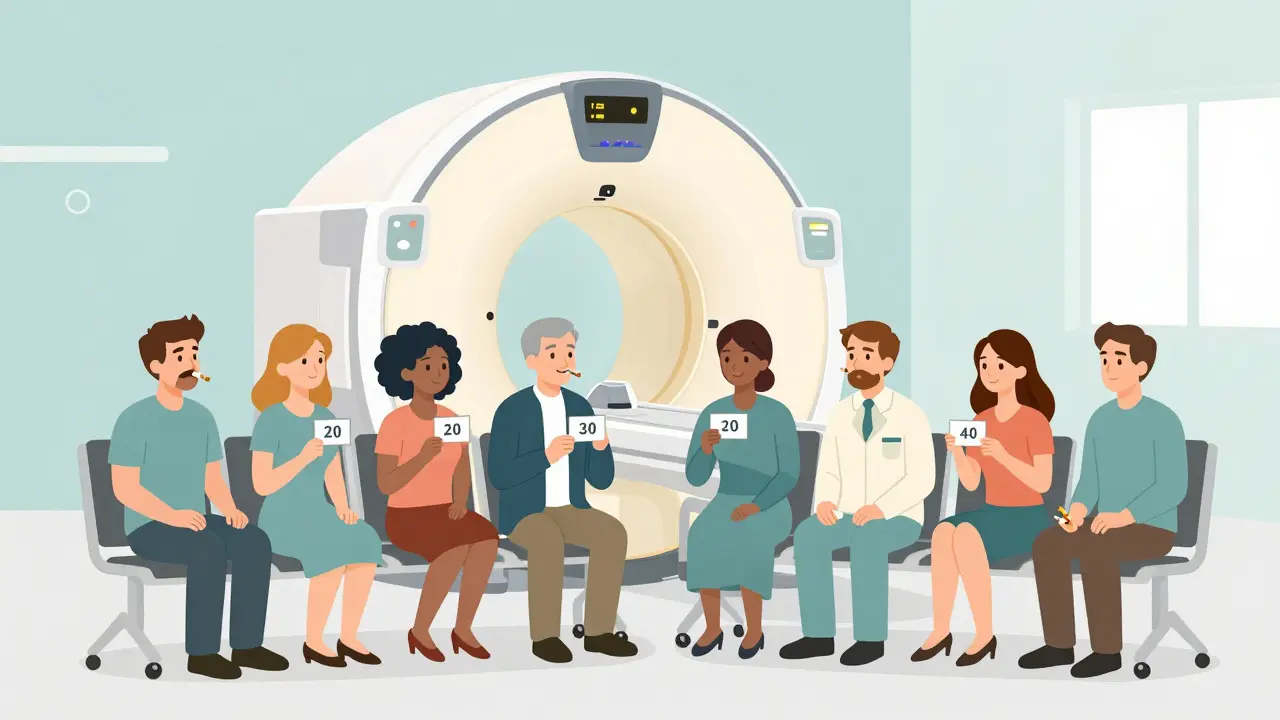
Every year, more people die from lung cancer than from breast, colon, and prostate cancers combined. And yet, most cases are still caught too late - when treatment options are limited and survival rates drop to just 6%. The good news? We now have tools to catch lung cancer early, especially in people who smoke or used to smoke. And when caught early, survival jumps to nearly 60%. The problem isn’t lack of science - it’s lack of action.
Who Should Be Screened? It’s Not Just Long-Term Smokers Anymore
If you smoked a pack a day for 20 years, you’re eligible for lung cancer screening. That’s the old rule. But since 2023, the American Cancer Society changed the game. Now, screening starts at age 50, not 55. And it doesn’t matter if you quit smoking 20 years ago - you still qualify. That’s a big deal because research shows your risk doesn’t disappear after 15 years. A 2022 JAMA Oncology study found people who quit 15 to 30 years ago still had 2.5 times higher risk of lung cancer than people who never smoked. The U.S. Preventive Services Task Force (USPSTF) still requires you to have quit within the last 15 years. But the American Cancer Society’s 2023 update removed that cutoff entirely. Why? Because ignoring former smokers who quit decades ago leaves millions at risk. The CDC estimates that 14.5 million Americans now qualify under updated guidelines. But only about 2.6 million actually got screened in 2021. That’s less than 20%. Screening isn’t for everyone. If you have severe heart or lung disease that makes surgery risky, or if you’re unwilling to treat cancer if found, screening won’t help. It’s meant for people who can still benefit from early treatment.How Screening Works: Low-Dose CT Scans
The only proven way to catch lung cancer early is a low-dose CT scan, or LDCT. It’s not a regular chest X-ray. It’s a quick, painless scan that uses 70-80% less radiation than a standard CT. The machine takes hundreds of detailed images of your lungs in seconds. No needles. No fasting. No prep. The scan finds tiny nodules - small spots that could be cancer. Most of them aren’t. In fact, about 96% of positive scans turn out to be false alarms. That’s why follow-up is critical. A small nodule might be monitored with another scan in 3 to 6 months. If it grows, you’re referred for biopsy or surgery. If it shrinks or stays the same, it’s likely harmless. To be accurate, the scan must be done at an accredited facility using specific settings: 120 kVp, 30-50 mAs, and slice thickness between 1.25 and 2.5 mm. Not every hospital or clinic meets these standards. The American College of Radiology only accredits about 2,800 centers nationwide. If you live in a rural area, you might have to drive hours for one.Why So Few People Get Screened - And How to Fix It
You’d think with clear guidelines and proven results, screening would be common. But it’s not. Four big reasons:- Doctors don’t talk about it. A 2022 AMA survey found 42% of primary care doctors didn’t even know the updated guidelines.
- Patients don’t know they’re eligible. Many think only heavy, current smokers qualify. They don’t realize former smokers, even those who quit 20 years ago, are still at risk.
- Access is uneven. Rural areas have 67% fewer screening centers than cities. Black Americans are 35% less likely to be screened than white Americans.
- Insurance confusion. Medicare covers screening for people 50-77 with a 20-pack-year history. But some private insurers still use the old 30-pack-year rule and age 55 cutoff.
Targeted Therapy: When Early Detection Meets Precision Medicine
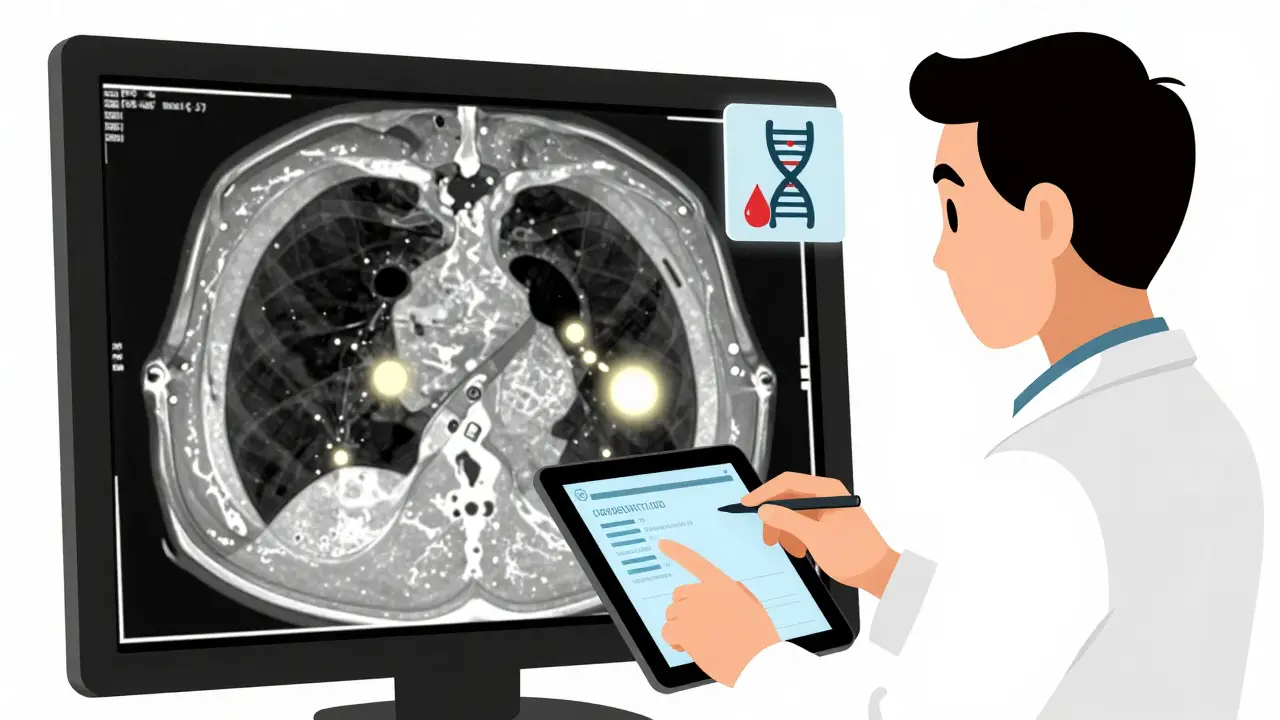
Finding cancer early is only half the battle. The other half is treating it effectively. That’s where targeted therapy comes in. Unlike chemotherapy, which attacks all fast-growing cells, targeted drugs lock onto specific mutations in cancer cells. About 15-20% of lung cancers have an EGFR mutation. For those patients, drugs like osimertinib (brand name Tagrisso) are a game-changer. In the ADAURA trial, patients with early-stage EGFR-positive lung cancer who took osimertinib after surgery had an 83% lower risk of cancer returning. That’s not just survival - it’s long-term remission. The International Association for the Study of Lung Cancer predicts that by 2025, 70% of early-stage lung cancers found through screening will have a targetable mutation. But if the cancer is found late, that number drops to 30%. Screening doesn’t just catch cancer early - it unlocks better treatment options. New blood tests, called liquid biopsies, are being tested to detect these mutations before a tumor even shows up on a CT scan. Trials like NCT04541082 are already underway. The goal? To one day use a simple blood test to identify high-risk people and start targeted therapy before a tumor forms.AI Is Making Screening Smarter
False positives are the biggest downside of LDCT. They cause stress, extra scans, and sometimes unnecessary biopsies. That’s where artificial intelligence steps in. In January 2023, the FDA approved LungQ by Riverain Technologies - the first AI tool designed to help radiologists interpret lung scans. In real-world tests, it cut unnecessary follow-ups by 22%. How? It flags only the nodules that are most likely to be cancer, ignoring harmless shadows, blood vessels, or scars. Hospitals using AI have seen faster read times and more consistent results. One study in Radiology showed AI reduced human error by 15-20%. It doesn’t replace doctors - it makes them better.
What’s Next? The Future of Lung Cancer Detection
The next big step? Personalized screening. Right now, eligibility is based almost entirely on smoking history. But not all smokers get cancer. And not all non-smokers are safe. The National Cancer Institute is launching the PACIFIC trial in 2024. It will follow 10,000 people and test whether adding genetic risk scores, air pollution exposure, and family history can make screening more precise. The idea: give high-risk people scans every year. Give low-risk people scans every three years - or none at all. By 2030, experts predict screening programs will combine LDCT scans with blood-based genetic markers and AI analysis. The goal: turn lung cancer from a death sentence into a manageable condition - especially for people who smoked.What You Can Do Today
If you’re a current or former smoker:- Calculate your pack-years: Multiply packs per day by years smoked. One pack a day for 20 years = 20 pack-years.
- If you’re 50 or older and have 20+ pack-years, ask your doctor about LDCT screening - even if you quit decades ago.
- Make sure the facility is ACR-accredited.
- Ask about smoking cessation support. Most screening centers offer it, and 70% of smokers want to quit.
- If you’re under 50 or have a family history of lung cancer, talk to a specialist. New risk models may apply to you.
Do I need a referral to get a lung cancer screening?
Yes, you usually need a referral from your doctor. Medicare and most insurers require a shared decision-making visit - a 15-minute conversation where your doctor explains the risks and benefits of screening. This isn’t just paperwork - it’s your chance to ask questions and make sure you understand what to expect.
Is lung cancer screening covered by insurance?
Yes, under the Affordable Care Act, most private insurers and Medicare must cover annual LDCT screening without a copay if you meet the criteria. Medicare covers people aged 50-77 with a 20-pack-year smoking history who currently smoke or quit within the past 15 years. Some private plans still use outdated rules - check with your insurer before scheduling.
What if the scan finds a nodule? Does that mean I have cancer?
No. Over 96% of positive scans are false positives. A nodule is just a spot - it could be scar tissue, an infection, or a benign growth. Your doctor will likely recommend a follow-up scan in 3 to 6 months to see if it grows. Only if it changes size or shape will you need a biopsy. Don’t panic. Follow-up is routine, not alarming.
Can non-smokers get screened for lung cancer?
Currently, guidelines focus on smokers and former smokers. But about 20% of lung cancer deaths occur in people who never smoked. Research is underway to find better risk markers - like genetics, radon exposure, or air pollution - that could expand screening to non-smokers in the future. For now, if you’re a non-smoker with symptoms like persistent cough or unexplained weight loss, talk to your doctor immediately.
How often should I get screened?
Once a year, as long as you meet the eligibility criteria and are in good enough health to treat cancer if found. Skipping a year reduces the benefit. Annual scans have been shown to reduce lung cancer deaths by 20% in large studies. If you quit smoking, you still need annual scans - your risk doesn’t disappear.
Micheal Murdoch
January 9, 2026 AT 23:08It’s wild how we’ve got the tech to catch lung cancer early, but the system still treats it like a dirty secret. I’ve seen friends quit smoking 20 years ago and still feel guilty, like they don’t ‘deserve’ screening. But science doesn’t care about guilt-it cares about biology. Your lungs don’t forget. The risk lingers. And if we’re serious about saving lives, we stop making people prove they’re ‘worthy’ of care. Screening isn’t a reward for being good. It’s a right.
Meghan Hammack
January 10, 2026 AT 18:17My dad quit 25 years ago. He never got screened. He died last year. I wish someone had told him he still qualified. It’s not just about smoking-it’s about being alive long enough to care.
Ashley Kronenwetter
January 11, 2026 AT 11:10While I appreciate the intent behind expanding screening eligibility, we must acknowledge the potential for overdiagnosis and the psychological burden of false positives. The medical community must prioritize informed consent and structured follow-up protocols to ensure that screening does not inadvertently cause more harm than good.
Matthew Maxwell
January 11, 2026 AT 17:58Let’s be honest-this isn’t about science. It’s about guilt. People who smoked for decades shouldn’t be handed free scans like it’s a participation trophy. If you chose to smoke, you accepted the risk. Now you want the system to fix it? That’s not prevention-that’s enabling. The real solution is to stop smoking, not to scan everyone who ever lit up.
Ian Long
January 13, 2026 AT 14:24I get the frustration, but Matthew’s point misses the bigger picture. This isn’t about punishing or rewarding-it’s about saving lives. The data doesn’t lie: early detection saves. And if we’re going to talk about personal responsibility, then let’s also talk about how access is unequal. A Black woman in rural Mississippi doesn’t have the same chance as a white man in Boston. This isn’t about morality. It’s about justice.
Angela Stanton
January 14, 2026 AT 19:39LDCT + AI + liquid biopsy = next-gen oncology stack 🚀. EGFR+ patients are basically living in the future already-Tagrisso is basically a magic bullet. But the real bottleneck? Fragmented EHRs and radiology workflows that still run on Windows XP vibes. We need interoperability, not just more scans. Also, 96% false positive rate? That’s not a flaw-it’s a feature. It’s the price of sensitivity. But AI is finally bringing us to the sweet spot. #PrecisionMedicine #LungCancerAwareness
Phil Kemling
January 15, 2026 AT 13:24What does it mean to be ‘at risk’? Is it a number-pack-years, age, BMI-or is it the quiet fear that lingers after you’ve smoked for twenty years? The scan doesn’t just detect nodules. It forces a confrontation with time, with choices, with mortality. Maybe the real breakthrough isn’t the CT machine. Maybe it’s the moment someone finally asks, ‘What if I’m next?’
Diana Stoyanova
January 17, 2026 AT 08:40Okay, listen. I’m not a doctor, but I work in a clinic and I’ve seen it firsthand. People think ‘screening’ means ‘you have cancer.’ NO. It means ‘we caught it before it killed you.’ I had a 68-year-old woman come in last month-quit in ‘99, never thought she qualified. Got the scan, found a 4mm nodule. Follow-up in 6 months-still there, no growth. She cried. Not because she had cancer. Because she realized she still had time. We need to stop making this scary. We need to make it normal. Like getting a flu shot. Like brushing your teeth. This isn’t a luxury. It’s basic self-care. And if your doctor doesn’t bring it up? Ask. Demand it. You’re worth it.
Elisha Muwanga
January 18, 2026 AT 01:36Why are we spending billions on scans for people who made poor life choices? We could be funding better education, better nutrition, better public health. Instead, we reward bad habits with free medical care. This isn’t compassion-it’s enabling a culture of irresponsibility. If you want to live longer, don’t smoke. Period. No exceptions. No taxpayer-funded safety nets for self-inflicted harm.
Maggie Noe
January 19, 2026 AT 21:32It’s funny how we’ll screen for cancer but won’t screen for loneliness. 😔 I’ve known people who smoked because they were lonely. Who quit because they were tired. Who never got screened because they didn’t think anyone cared. Maybe the real epidemic isn’t cancer-it’s the silence around it. We need more than scans. We need more than doctors. We need people who show up. 💙
Gregory Clayton
January 20, 2026 AT 13:10Bro. I smoked for 15 years. Quit cold turkey in 2015. Got my scan last year. Zero nodules. Felt like I won the lottery. But here’s the thing-I didn’t even know I was eligible until my cousin told me. My PCP? Never mentioned it. That’s not an oversight. That’s negligence. We need to stop treating lung cancer like it’s a shame. It’s a public health crisis. And we’re sleeping on it.