
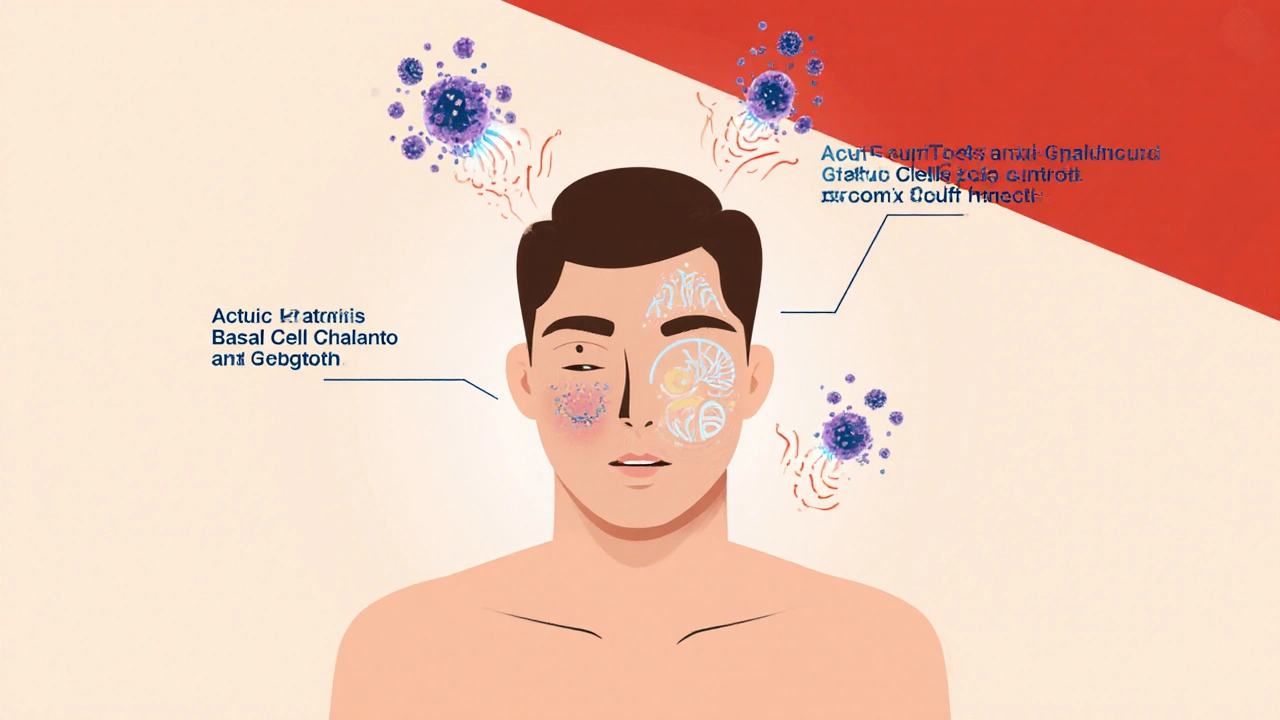
Skin Treatment Comparison Tool
Find Your Best Skin Treatment Option
Answer these questions to get personalized recommendations for your skin condition.
Recommended Treatment Options
Imiquad Cream is a brand name for imiquimod, a topical immunotherapy used to treat certain skin conditions like actinic keratosis, basal cell carcinoma, and genital warts. It doesn’t kill abnormal cells directly. Instead, it tricks your immune system into recognizing and attacking them. That’s why it works slowly - sometimes taking weeks or months - but it often leaves less scarring than surgery or freezing. Still, it’s not the only option. Many people wonder: are there better, faster, or cheaper alternatives?
How Imiquad Cream Works
Imiquad Cream contains 5% imiquimod. When applied to the skin, it triggers the release of cytokines - signaling proteins that activate immune cells like dendritic cells and T-cells. These cells then target abnormal skin cells. It’s not a chemical burn or a poison. It’s more like sending out a distress signal your body already knows how to answer.
For actinic keratosis (pre-cancerous sun spots), you typically apply it three times a week for 16 weeks. For small basal cell carcinomas, it’s used five times a week for six weeks. For genital warts, it’s applied three times a week until the warts clear, up to 16 weeks. The treatment is slow, but studies show clearance rates of 50-80% depending on the condition and how consistently it’s used.
Side effects are common: redness, swelling, itching, flaking, and sometimes flu-like symptoms. These aren’t signs it’s not working - they’re proof your immune system is responding. Still, many people stop using it because the irritation feels too harsh.
Alternative 1: Fluorouracil Cream (5-FU)
Fluorouracil, sold under brands like Efudix or Carac, is a chemotherapy drug applied topically. Unlike imiquimod, it directly kills rapidly dividing cells - both abnormal and healthy ones. That’s why it works faster: you usually see results in 2-6 weeks.
It’s approved for actinic keratosis and sometimes used off-label for superficial basal cell carcinoma. The treatment course is shorter - once or twice daily for 2-4 weeks. But the side effects are intense: burning, crusting, severe redness, and open sores. Many patients describe it as feeling like a bad sunburn that won’t go away.
Compared to Imiquad Cream, 5-FU clears lesions faster but leaves more visible inflammation. It’s also cheaper in many countries. If you need quick results and can tolerate discomfort, it’s a solid option. If you want a gentler approach that builds long-term immunity, Imiquad might be better.
Alternative 2: Photodynamic Therapy (PDT)
Photodynamic therapy combines a light-sensitive drug - usually aminolevulinic acid (ALA) or methyl aminolevulinate (MAL) - with a special red or blue light. The drug is applied to the skin, absorbed by abnormal cells, and then activated by the light. This destroys the targeted tissue.
PDT is often used for actinic keratosis and some basal cell carcinomas. A single session can clear multiple lesions in under an hour. Recovery is faster than with topical creams - redness fades in 1-2 weeks. Success rates are high: up to 90% for thin lesions.
The downside? It’s expensive and not always covered by insurance. You also need to avoid sunlight for 48 hours after treatment. If you live in a sunny place like Sydney, this can be tricky. But if you want a one-time treatment with minimal long-term skin changes, PDT beats waiting months for cream to work.
Alternative 3: Cryotherapy (Liquid Nitrogen)
Cryotherapy is the oldest and most common treatment for actinic keratosis and small warts. Liquid nitrogen freezes the abnormal tissue, killing it instantly. It’s done in a doctor’s office in under a minute.
It works fast - lesions often peel off in 1-2 weeks. It’s also the cheapest option, often costing less than $50 per session. But it’s not always precise. It can damage healthy skin around the lesion, leading to white spots or scarring, especially on darker skin tones.
Multiple sessions are often needed. For widespread actinic keratosis, it’s impractical. For a single wart or spot, it’s hard to beat. Unlike Imiquad Cream, it doesn’t train your immune system. It just removes what’s visible. That means new lesions can appear later if the underlying sun damage isn’t addressed.
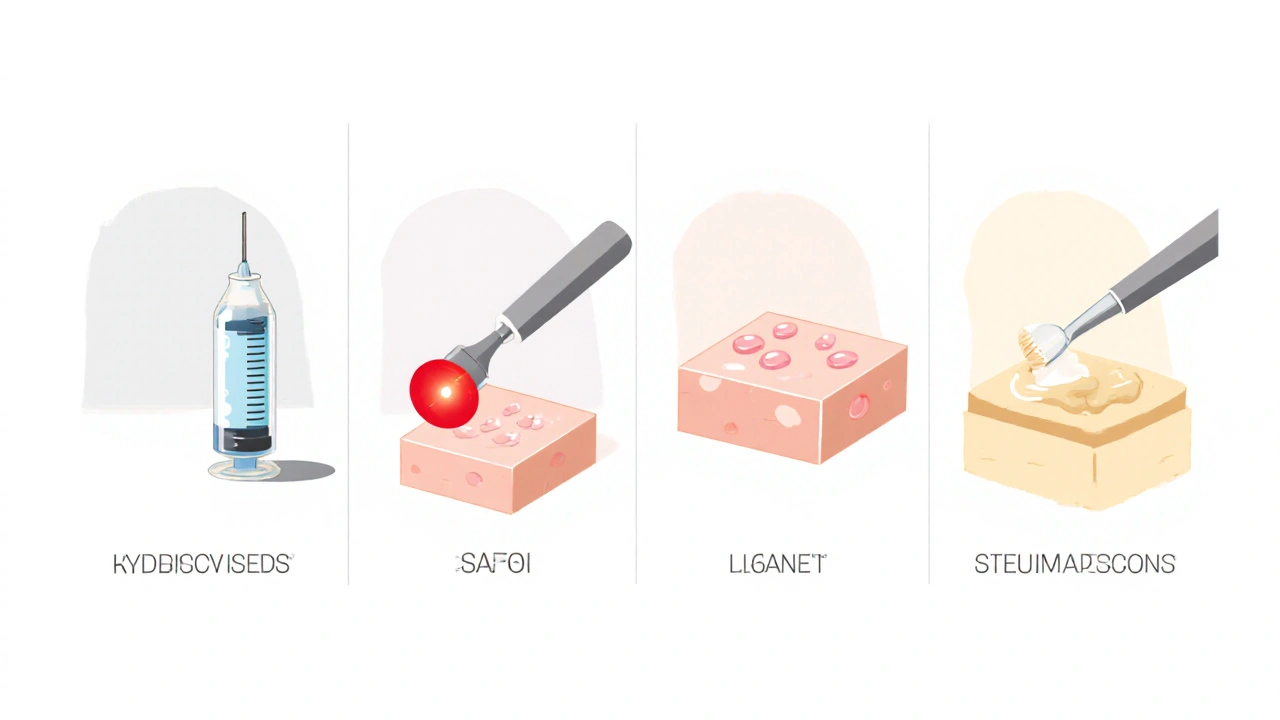
Alternative 4: Ingenol Mebutate (Picato)
Ingenol mebutate, sold as Picato, is a plant-derived compound that causes rapid cell death and immune activation. It’s approved for actinic keratosis and comes in two strengths: a 0.015% gel for the face/scalp (used for 3 days) and a 0.05% gel for the trunk/extremities (used for 2 days).
It works faster than Imiquad Cream. Most people see results within a week. The treatment is short, which improves compliance. But the side effects are intense: blistering, crusting, swelling, and pain that peaks on day 2 or 3. It was withdrawn from the U.S. market in 2020 due to concerns about long-term skin cancer risk, but it’s still available in Australia and other countries under strict supervision.
If you’re looking for a short-course treatment and your doctor approves it, it’s effective. But because of safety concerns, many clinicians now prefer imiquimod or PDT instead.
Alternative 5: Surgical Removal
For larger or deeper basal cell carcinomas, surgery is often the gold standard. Options include excision (cutting it out), Mohs surgery (layer-by-layer removal with immediate microscopic checks), and curettage with electrodessication (scraping and burning).
Surgery removes the lesion immediately. Cure rates for basal cell carcinoma are above 95%. It’s the most reliable method for high-risk or aggressive cases. But it leaves a scar, requires local anesthesia, and isn’t suitable for large areas or multiple lesions.
Imiquad Cream is often chosen when surgery isn’t ideal - for example, if the lesion is in a sensitive area like the nose or eyelid, or if the patient has multiple lesions and can’t handle repeated procedures. Creams are non-invasive, but they’re not always as effective for thick or nodular cancers.
Which Alternative Is Right for You?
Choosing between Imiquad Cream and its alternatives comes down to four things: the type of skin condition, your tolerance for side effects, how quickly you want results, and your budget.
- If you have multiple sun spots and want to prevent future skin cancer, Imiquad Cream or 5-FU may help train your skin’s defenses over time.
- If you need fast results and can handle discomfort, cryotherapy or PDT are strong choices.
- If you want minimal treatment time, ingenol mebutate (if available) or PDT work in days, not weeks.
- If the lesion is large, deep, or suspicious, surgery is still the safest bet.
- If cost is a concern, cryotherapy and 5-FU are usually the most affordable.
One thing all these treatments have in common: they don’t fix sun damage. No cream or procedure replaces daily sunscreen, wide-brimmed hats, and avoiding midday sun. If you’re using Imiquad Cream for actinic keratosis, you’re likely someone who’s had years of UV exposure. The real goal isn’t just removing one spot - it’s preventing the next ten.

What About Natural or Over-the-Counter Options?
Some people turn to tea tree oil, apple cider vinegar, or curcumin creams thinking they’re safer or more natural. But there’s no solid evidence they work for pre-cancerous lesions or skin cancer. A 2023 review in the Journal of the American Academy of Dermatology found that while tea tree oil may help with some warts, it’s unreliable and can cause allergic reactions.
Over-the-counter wart removers containing salicylic acid can work for common warts - but not genital warts or actinic keratosis. These are medical conditions that need proper diagnosis. Self-treating with home remedies can delay effective care and let skin cancer grow unnoticed.
When to Stick With Imiquad Cream
Imiquad Cream still has a place. It’s especially useful when:
- You have multiple small lesions across a broad area (like the face or scalp)
- You want to avoid surgery or scarring
- Your immune system is strong enough to respond
- You’re okay with a slower process that builds long-term protection
It’s also the only topical treatment proven to reduce the chance of new lesions forming after clearance - something cryotherapy and 5-FU don’t do as reliably.
Final Thoughts
There’s no single best treatment for everyone. Imiquad Cream isn’t the fastest, the cheapest, or the least irritating. But it’s one of the few that doesn’t just remove the problem - it helps your body learn not to let it come back. That’s powerful.
What matters most is matching the treatment to your life. If you’re busy and hate daily creams, PDT or cryotherapy might be better. If you’re worried about scarring or have sensitive skin, Imiquad Cream might be worth the wait. If cost is tight, 5-FU or cryotherapy are solid choices.
Always get a proper diagnosis first. What looks like a wart could be something more serious. And never skip follow-up appointments - skin cancer can return even after successful treatment.
Is Imiquad Cream the same as imiquimod?
Yes. Imiquad Cream is a brand name for the generic drug imiquimod. Both contain the same active ingredient at the same strength (usually 5%). The only differences are the brand packaging, price, and possibly inactive ingredients like the cream base. Generic imiquimod is often cheaper and works just as well.
Can I use Imiquad Cream for acne or regular warts?
No. Imiquad Cream is not approved for acne or common warts on hands or feet. It’s specifically designed for actinic keratosis, basal cell carcinoma, and genital warts. Using it for other conditions won’t help and may cause unnecessary irritation. For common warts, over-the-counter salicylic acid or cryotherapy from a pharmacist is safer and more effective.
How long does it take for Imiquad Cream to work?
It varies. For actinic keratosis, you usually need 12-16 weeks of treatment. For genital warts, it can take 8-16 weeks. You won’t see results in the first few days. The redness and flaking are signs your immune system is working, but full clearance often takes months. Patience is key.
Can I apply Imiquad Cream to my face?
Yes, but with caution. Imiquad Cream is commonly used on the face for actinic keratosis, especially on the forehead, cheeks, and nose. However, the skin there is thinner and more sensitive. Side effects like swelling and crusting can be more noticeable. Always follow your doctor’s instructions on how much to use and how often. Avoid getting it near your eyes, lips, or inside your nose.
What happens if I stop using Imiquad Cream too early?
Stopping early increases the chance the lesion will come back. Imiquad Cream works by training your immune system. If you stop before the full course, your body may not have had enough time to fully clear the abnormal cells. Incomplete treatment can also lead to resistance or more aggressive recurrence. Always finish the prescribed course unless your doctor tells you to stop due to severe side effects.
Lauren Hale
November 19, 2025 AT 19:18Imiquad is a great option if you're dealing with multiple actinic keratoses and want to avoid scarring. I've seen patients go from covered in sun spots to smooth skin over 16 weeks - no surgery, no downtime. The key is consistency. People give up after two weeks because their skin looks like a tomato, but that’s the immune system doing its job. Stick with it. And yes, sunscreen afterward isn’t optional - it’s mandatory.
Sherri Naslund
November 21, 2025 AT 08:27lol why are we even talking about this when Big Pharma just wants you hooked on creams forever? I used imiquimod for 3 months and my face looked like a war zone. Then I just started rubbing garlic on it. Guess what? The spots vanished in 2 weeks and my breath smelled like death. Worth it. Also, your doctor’s probably getting kickbacks from 3M. Just saying.
rachna jafri
November 23, 2025 AT 03:26USA and Canada pushing these overpriced creams while India treats skin cancer with turmeric paste and prayer since the 1980s. You think your $300 cream is science? We’ve been curing warts with neem oil since before your great-grandma was born. Modern medicine is just old remedies with a patent and a price tag 100x higher. And don’t even get me started on how they banned Picato here but sell it in the West like it’s holy water.
darnell hunter
November 23, 2025 AT 11:08While the clinical efficacy of imiquimod is well-documented in peer-reviewed literature, the assertion that it "trains" the immune system is an oversimplification. The cytokine cascade induced by TLR7/8 agonism is a localized, transient response, not a systemic immunological memory. Furthermore, comparative studies show no statistically significant reduction in new lesion formation versus 5-FU when adjusted for treatment adherence. The perceived superiority is largely anecdotal.
Hannah Machiorlete
November 25, 2025 AT 09:37my dermatologist gave me imiquad and i cried for three weeks straight. my face looked like a burnt marshmallow and my boyfriend left me. i’m not even mad. i’m just… empty. like my skin and my soul were both just… processed. why do we do this to ourselves? why do we let doctors turn our bodies into science experiments?
Martin Rodrigue
November 26, 2025 AT 16:22There is a critical misconception in the post regarding PDT. While it’s true that PDT offers high clearance rates for superficial lesions, its efficacy drops significantly for nodular basal cell carcinomas - less than 60% in some trials. Moreover, the use of ALA requires strict light exposure protocols; inadequate dosing leads to recurrence. The claim that PDT "beats waiting months for cream" ignores the fact that multiple PDT sessions are often required, and insurance denials are common. Imiquimod, despite its slow onset, offers a predictable, home-based regimen with documented long-term immunomodulatory effects that PDT lacks.
Greg Knight
November 27, 2025 AT 15:39Hey, if you’re considering Imiquad, don’t panic when your skin starts looking like a battlefield. That redness? That’s your body saying, "I see you, and I’m coming for the bad cells." I’ve had patients who thought they were failing because they didn’t see results by week 4 - then boom, month 10, skin’s clear and they’re back at the beach. It’s not magic, it’s biology. And yeah, it’s annoying. But so is cancer. Pick your battle. Stick with the plan. You got this.
Ashley Miller
November 29, 2025 AT 01:44They’re all lies. The FDA banned Picato because it makes people’s skin turn into lava. But guess what? The same company that made Picato also makes Imiquad. They just swapped the label. You think your immune system is fighting cancer? Nah. You’re just burning your skin with a placebo that costs $500 a tube. Sunscreen? That’s the real cure. And they don’t want you to know that.